Voice of Business: Hiring Persons with Disabilities

With employers across the country facing significant barriers to finding the skilled labour they need to thrive and expand, there’s one solution that we need to do better on — hiring persons with disabilities.

In a time when accommodating the health and safety of employees has risen to new priority levels and technology that has made it easier than ever to adapt and accommodate, there’s little excuse for not expanding our mindset on what the physical requirements of the job are.

According to the Discover Ability Network (DAN), 6.2 million Canadians have disabilities and it’s a group that anyone can be a part of, whether temporarily or permanently. More than 75 per cent of people with disabilities acquire them as adults.

Hiring persons with disabilities typically leads to cost reductions related to turnover, absenteeism, safety and improvements in productivity. In addition to finding a new talent pool, companies that hire persons with disabilities find that bringing people with different perspectives and experiences improves their products and services.

The DAN also has found that there is typically no or low cost to provide accommodations.

The Ontario Chamber of Commerce is partnering with the Discover Ability Network to help provide employers with the tools and resources they need to expand their workforce in a more inclusive manner. When it comes to hiring people with disabilities, the business opportunity is irrefutable.

The Discover Ability Network provides tools and supports through in-person workshops, webinars and online resources to help businesses understand the Accessibility for Ontarians with Disabilities Act, why and how to become a more inclusive employer, and how to hire and retain talent from the persons with disabilities labour pool.

Local chambers of commerce and boards of trade, industry associations, not-for-profit organizations, and businesses can request in-person and online training on a variety of topics related to accessibility, inclusion and hiring from the persons with disabilities talent pool. Training is also available to staff of organizations that support job seekers with disabilities, such as post-secondary institutions and employment service providers, as well as training targeted to persons with disabilities to help them become more confident job seekers. Find out more here: https://occ.ca/discoverability/

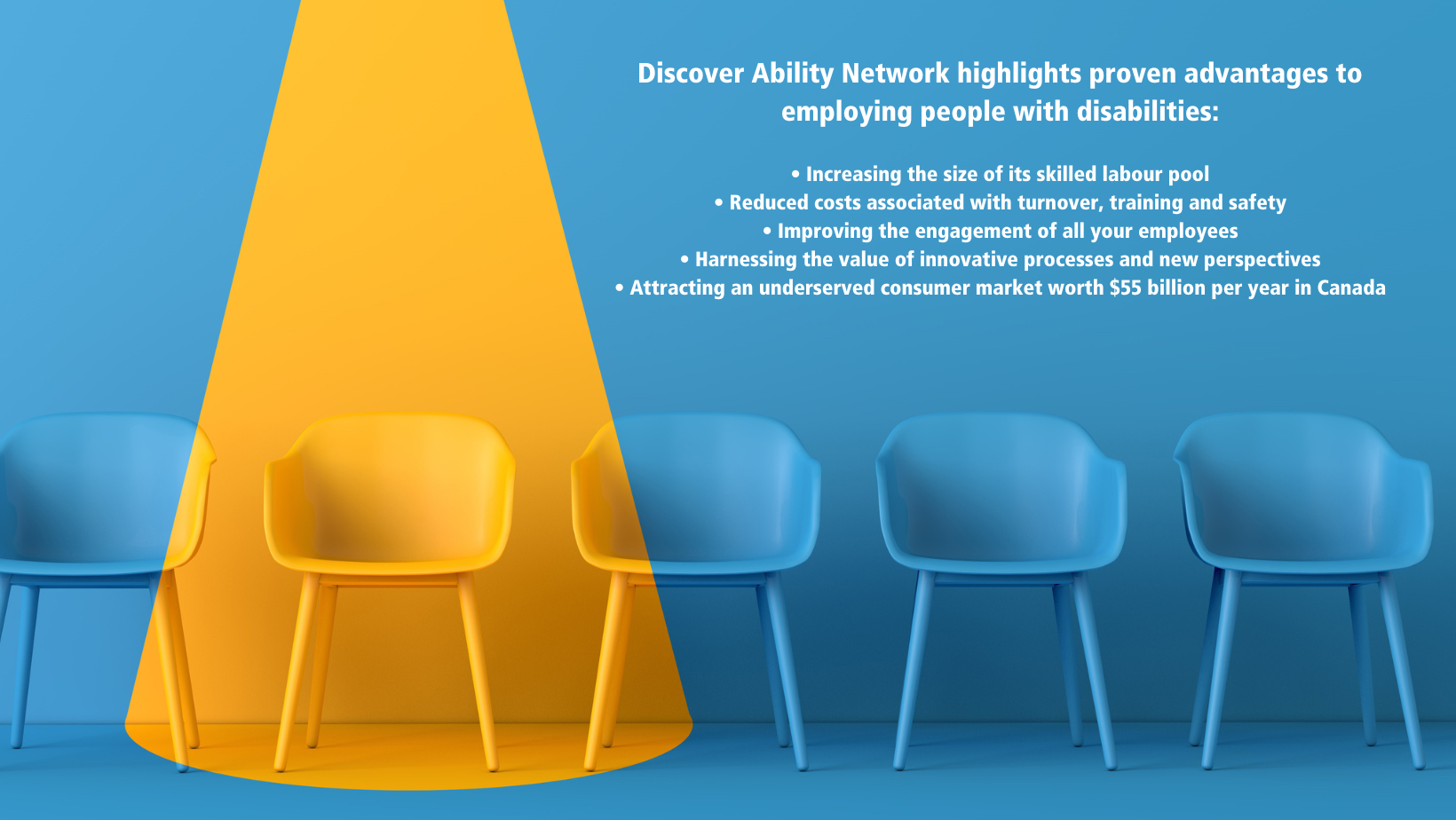
The DAN highlights proven advantages to employing people with disabilities:

  • Increasing the size of its skilled labour pool

  • Reduced costs associated with turnover, training and safety

  • Improving the engagement of all your employees

  • Harnessing the value of innovative processes and new perspectives

  • Attracting an underserved consumer market worth $55 billion per year in Canada

If you’re an employer interested in learning more, join the virtual Discover Ability Network ROI Conference on May 25 and 26 from 9 a.m. to noon. This free conference will discuss the value of hiring inclusively, the tools and resources to support building disability-confident organizations, and the importance of inclusive hiring to workforce development and future economic prosperity.

Get your tickets here: https://www.eventbrite.ca/e/diversity-in-business-roi-conference-tickets-310056205457

Find out more about hiring persons with disabilities and what resources chambers of commerce have to offer on the OCC discoverability page: https://occ.ca/discoverability/

Content provided by the Peterborough and the Kawarthas Chamber of Commerce.

Engage with us on social media on Twitter, Instagram, Facebook and Tiktok. Write to us at tips@ptbocanada.com. Sign up for PTBOBuzz newsletter here.

Voice of Business: Further Investment In Barriers to Business Needed

The Government of Ontario’s budget is out, addressing some pressing issues for local businesses while falling short on others.

A budget released days before an election writ drops carries a bit more politics than it might in another year, but poll projections hint that there’s a reasonable chance our current government could be re-elected and implement this budget later this year.

The Ontario Chamber of Commerce's response to the Ontario budget highlights some welcome news:

  • Measures to address Ontario’s current labour shortages and future workforce needs

We welcome commitments to reduce barriers to foreign credentials and new investments in the skilled trades strategy.

  • Commitments to support business predictability

Ontario’s Plan to Stay Open focuses on improving pandemic preparedness and addressing key challenges such as labour shortages in the healthcare sector.

  • Pro-growth policies

The proposed modernization of capital markets and venture capital investments will enable small businesses and entrepreneurs to access growth financing. Additionally, the Building Ontario Business Initiative seeks to level the playing field for Ontario businesses competing for government contracts.

  • Initiatives to bolster our health care system.

Expanding medical training and investing in health care infrastructure and capacity are critical. Plans also focus on Ontario’s aging population through the dementia strategy, seniors care at home tax credit and investments in long-term care.

  • Continued action on critical transportation infrastructure

Rail, roads, and public transit will help businesses connect with workers and markets more efficiently.

On the what’s lacking side of things are four key issues we’ve been advocating for: immigration, supply chain, interprovincial trade and climate change.

Immigration starts at the federal level, but our provinces play a large role in where people settle, what skills we recognize, and how they are supported. The government has made significant strides in addressing labour market issues through immigration, but one missing aspect has been the where.

Approximately 35 per cent of all immigrants moving to Canada locate to Toronto. Though Toronto is going through labour force challenges of its own, its concentration of new immigrants can be problematic for other communities facing low or even negative population growth. We would like to see our provincial government provide more support to encourage immigration to rural and northern communities.

Chambers of commerce from across Ontario are calling on our provincial government to create a task force in partnership with private sector leaders to take a holistic approach to address our supply chain challenges and vulnerabilities. It’s a critical component of our economic recovery.

Businesses are struggling to get raw materials, retail inventory and ingredients in a timely, consistent manner. The costs have gone up while service has declined. We need investments in physical infrastructure as well as cyber security to protect our supply chain and get our goods moving in a timely and efficient manner.

Participating in the Regulatory Reconciliation and Cooperation Table is helpful but we need to do more when it comes to interprovincial trade and making labour more mobile. We want to see our government take on a lead role in unlocking internal markets for local businesses. We would like to see Ontario sign a mutual recognition agreement with other provinces and territories.

Climate change is a business issue. It’s going to cost us money to address it, but the status quo is already costing us significantly and will cost more yet down the road. We’re encouraged to see more investments in electric vehicle supply chains, but the budget lacks a more comprehensive approach to climate change, including a plan to reduce greenhouse gas emissions across sectors, industries and communities.

Our role as a chamber is to be non-partisan advocates for our business community. Regardless of what political party leads this province moving forward, our economic recovery is going to take investments that enable our private sector to do what they do best and create prosperity.

Content provided by the Peterborough and the Kawarthas Chamber of Commerce.

Engage with us on social media on Twitter, Instagram, Facebook and Tiktok. Write to us at tips@ptbocanada.com. Sign up for PTBOBuzz newsletter here.

Voice of Business: Provincial Election Priorities

With the Ontario provincial election coming up in a little over a month, it’s time to look at what the priorities are for the business community.

No matter what the political leanings of a party are — the business community will play an important role in our province’s economic rebound.

When it comes to elections, the Peterborough and the Kawarthas Chamber of Commerce is strictly non-partisan. We believe in advocating for local businesses and welcome the support of all parties and candidates in progressing policy that will build, support and provide opportunities for the local business community to thrive.

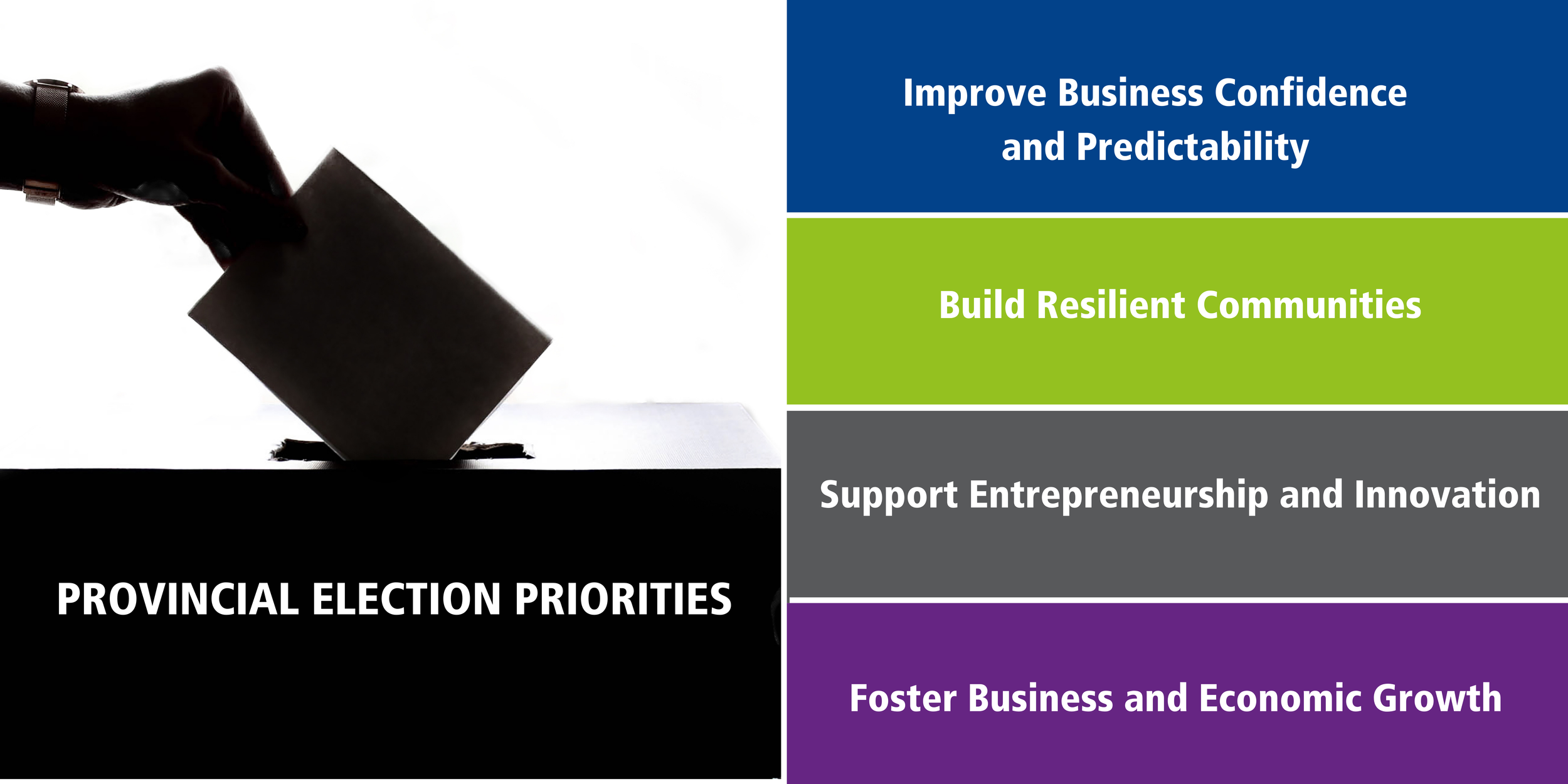
The Ontario Chamber of Commerce put together a four-point plan called Vote Prosperity which lays out the priorities of chambers of commerce and boards of trade for all parties across the province.

The four pillars are:

1. Improve Business Confidence and Predictability

Predictability is fundamental to business confidence, economic recovery and prosperity. Businesses need a stable policy environment with clear timelines, contracts, consultations, and strategies to help them plan for the future and make long-term investments. Given the uncertainty brought on by COVID-19, Ontario must also bolster its pandemic preparedness in response to ongoing and future threats.

2. Foster Business and Economic Growth 

The dual economic and public health crises of the past two years have left many businesses and households in Ontario with record levels of debt and financial instability. Pro-growth measures for business will fuel economic recovery. Ontario will need to focus on actions that support business access to the capital, markets and talent that they need to grow.

3. Build Resilient Communities

A strong economy is built by healthy and resilient communities. Ontario will need to address challenges within our health care system, the ongoing impacts of climate change, access to housing, municipalities’ fiscal capacity to support regional economies and infrastructure deficits.

4. Support Entrepreneurship and Innovation

Ontarians’ entrepreneurial spirit is one of the province’s greatest competitive advantages. Ontario will need to foster an environment that encourages new business ideas and investments to boost productivity and create the jobs of tomorrow.

Whoever forms our next government will have some difficult decisions to make. The last couple of years have been incredibly challenging but how we decide to invest in moving forward will have big implications for years to come. Key investments to drive our competitiveness include workforce development and training, immigration, technology, infrastructure, and clean energy. We need to look at removing unnecessary barriers to growth like outdated regulations, an inefficient tax system, obstacles to interprovincial trade and labour mobility.

Our next government is going to have to balance post-pandemic priorities that include our overstretched health care system, supporting key sectors and demographics that have been disproportionately impacted, fiscal pressures from an aging population, supply chain disruptions, and record-high inflation.

Ontario’s next government has a big job ahead of it. We’re asking all parties and candidates to listen to their local businesses and the needs and opportunities they’re presenting as a key component to building Ontario into the province we want it to become.

Content provided by the Peterborough and the Kawarthas Chamber of Commerce.

Engage with us on social media on Twitter, Instagram, Facebook and Tiktok. Write to us at tips@ptbocanada.com. Sign up for PTBOBuzz newsletter here.

Voice of Business: Employment Insurance

It’s time to review Employment Insurance.

One out of every 20 jobs in Canada is currently going unfilled.

The Canadian Chamber of Commerce’s March 2022 Labour Force Survey reveals the total to be 830,000 jobs.

“It seems like every survey shows businesses laser-focused on two issues limiting their recovery and posing the most significant barrier to economic growth: supply chain disruptions and labour shortages. Most businesses believe supply chain disruptions are with us for another year, maybe two, but our members see no end to Canada’s labour shortage crisis,” states Leah Nord, Canadian Chamber of Commerce Senior Director of Workforce Strategies and Inclusive Growth.

It's going to take a multi-faceted approach to properly address our labour challenges. It will take involvement from all levels of government, public institutions and the private sector all working together.

The Canadian Chamber of Commerce is advocating that this is the time to modernize Employment Insurance. The Government of Canada is engaging in consultations on EI. The EI system has not been reviewed in 70 years, something the CCC calls a once-in-a-lifetime opportunity to crack this stale nut wide open.

The CCC would like to see EI evolve towards becoming a talent development process that responds to the regional and sectoral labour market needs, supporting individuals through temporary job loss with financial and training resources. The CCC goes on to say that in order to achieve this we need a mechanism wherein all parties – business, labour and government – can engage in a meaningful and sustained way.

The latest unemployment numbers highlight that the issue is much bigger than simply getting people back to work. Unemployment dropped to the lowest it has been since 1974, hitting 5.3% in March. CCC Chief Economist Stephen Tapp expects to see the trend continue with unemployment dropping below 5% this year.

People are back to work.

It’s important to look at how we’re recovering. For example, Canada added 73,000 jobs in March of which 55,000 were men and 18,000 were women. Full-time work is leading growth, having added 93,000 jobs, while part-time employment dropped a further 20,000. While many people may prefer full-time work, part-time provides its own essential role in the economy by engaging people who require the added flexibility. Wages continue to rise, but struggle to keep pace with soaring inflation.

One key aspect of overhauling EI is to reposition people for the workforce. The system currently provides needed financial assistance while someone is out of work and essentially puts them back into the workforce to fill the same role they left. There is an opportunity to do better and use the EI process to develop much-needed talent.

We have to come to terms with the fact that dealing with such a large hole in our workforce is about more than finding enough bodies to fill those jobs. We can do better. We can modernize our workforce in ways that won’t require the same things to be done the same way we were doing them. Ultimately, this innovative approach to employment gaps will make our country more competitive.

Without access to talent for our businesses, our economy is at risk of stagnating. The timing couldn’t be worse considering the desperate situation many businesses are facing coming out of two years of COVID-19 public health measures.

The heart of our economy, our growth, and our prosperity is people. It’s time to do better about how we support, train, and engage our most valuable resource.


Content provided by the Peterborough and the Kawarthas Chamber of Commerce.

Engage with us on social media on Twitter, Instagram, Facebook and Tiktok. Write to us at tips@ptbocanada.com. Sign up for PTBOBuzz newsletter here.

Voice of Business: Some Hits and Misses in Optimistic Federal Budget

Economic growth is led by the private sector. It takes investment in their workforce, infrastructure, and innovation.

The 2022 federal budget has a lot to offer but time will tell if there’s enough emphasis on enabling the private sector to lead our economic recovery.

It’s encouraging to see our government prioritize investments in housing, reducing emissions, strengthening public health, and building a stronger workforce. Overall, our economic outlook is improving. Employment is up. Our GDP has come in higher than projected.

Where the criticism comes in is the lack of vision in the federal budget.

“Fiscal responsibility will become increasingly important amid inflation and rising interest rates,” states Rocco Rossi, President and CEO of the Ontario Chamber of Commerce, in a press release. “While Budget 2022 contains several growth-enabling investments, it lacks an overarching plan and vision for economic growth that will encourage private sector investment and reduce the debt-to-GDP ratio without the need for spending cuts or tax increases in the future. Now more than ever, it is critical for Canada to leverage private capital and reduce regulatory barriers that inhibit growth.”

The budget contains some significant positive investments. The federal government is tackling current housing issues. There are incentives to stimulate housing construction and a new Tax-Free Home Savings Account to help first-time buyers save up for a home.

We’re encouraged to see the government continue to prioritize investments in the VIA High Frequency Rail project, which includes Peterborough in a new dedicated passenger rail line between Toronto and Quebec City. The budget spells out further investment in planning and design steps.

There’s a big emphasis on net-zero emissions — and rightly so. Canada has made some big promises on the world stage to do its part to fight climate change. It’s encouraging to see the government work with the private sector, including investments in carbon capture technology, electric vehicles, and tax credits toward net-zero technologies. The government is also investing heavily in assisting the agriculture sector invest in low emissions technology.

Small and medium-sized businesses will see access to the small business tax rate gradually phased out once they reach $50 million of capital, up from $15 million. The government is also working on developing a plan for Employee Ownership Trusts, a tool that can help reward employees and increase retention.

Large banks and insurance companies are going to see a tax increase, prompting some concerns from the business community that these costs will get passed on to their customers.

The government is investing in a stronger workforce through new funding for training, tax credits to encourage seniors to continue longer in the workforce, and funding to support integration for persons with disabilities.

Our workforce is heavily dependent on outside help. The budget includes investments in the Temporary Foreign Worker program as well as assistance for immigration including expanding the program to recognize foreign credentials.

The budget comes up a bit short in a few critical areas. While there is money set aside for cybersecurity, it’s through the national defence sector. Chambers of commerce across the country have been advocating for more investment in cyber security for the private sector, especially as it impacts our supply chain. There’s a general lack of focus and investment in the supply chain, which is driving up costs and creating challenges for businesses and consumers.

Also missing is debt relief for hardest-hit businesses that used government support programs.

If nothing else, the 2022 budget is big on optimism. The federal government is making some much-needed investments in some business sectors that should lead us in the direction of recovery and growth. More can be done and for that, we’ll continue to advocate for a strong private sector to lead our economic growth.

Content provided by the Peterborough and the Kawarthas Chamber of Commerce.

Engage with us on social media on Twitter, Instagram, Facebook and Tiktok. Write to us at tips@ptbocanada.com. Sign up for PTBOBuzz newsletter here.