
Peterborough Blogs



Voice of Business: A Snapshot of Our Economy and Where It’s Headed
/After a surge in the first half of the year, Canada’s economy is slowing.
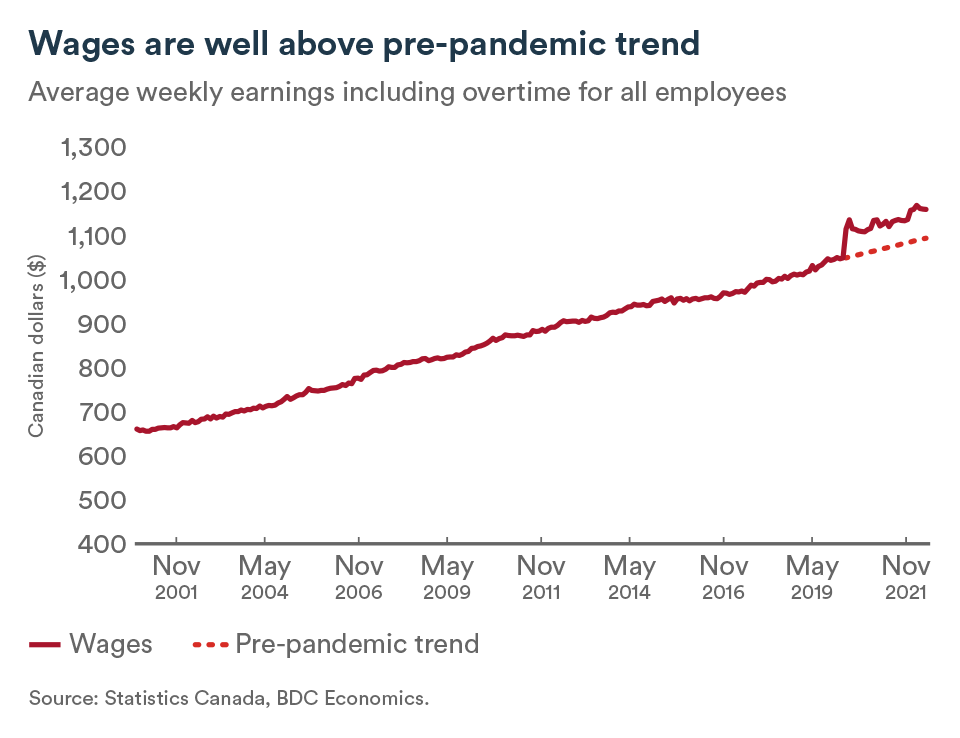
For the first half of the year, the economy grew at a rate of 3.3 per cent, but slowed to 0.1 per cent between June and July. A big part of this has been the Bank of Canada’s plan to tackle huge increases in the price of homes and overall inflation by hiking overnight interest rates from 0.25 per cent to 3.25 per cent.
While the overall purchase price of a home locally may still be out of reach for many first-time buyers, there’s no question the market has cooled. The Peterborough and the Kawarthas Association of Realtors reported the average home price in August dropped to $689,437, down from its peak of $885,153 back in February.
According to the Business Development Bank of Canada (BDC), the job market has cooled off as well with Canada losing 113,500 jobs over the last three months. This is partly due to the imbalance between the supply and demand of workers. Unemployment increased from a record low 4.9 per cent to a still historically low 5.4 per cent. But it’s still estimated that there are more than 1 million job vacancies right now.
While there are fewer jobs out there for workers, so far it hasn’t eased hiring woes by any significant degree. With that, the trend toward higher wages is expected to continue along with inflation.
As noted by BDC, “The scale that wage increases have taken in 2022 is significant. Hourly wages have increased on average by 4.0% year-to-date, compared to the historical pre-pandemic average of 2.7% growth. Moreover, in August 2022, wage growth was 5.4% year-over-year. This is the largest annual change in the last 20 years outside of the pandemic period.”
According to Statistics Canada, 64 per cent of businesses have boosted wages for current staff and 46 per cent say they have increased salary offers for new hires.
While a slowing economy is expected to eventually bring wage increases back down, BDC notes the demands of an aging workforce will add further pressure as we struggle to replace retirements.
Another key driver of inflation has been the price of fuel. Oil prices have been dropping since July to the point that the price at the pump is back to the level it was before the war in Ukraine. A few months ago we were paying more than $2 per litre, but now that has dropped to under $1.40.
It’s not just easing the cost of life for people, but it’s having an effect on supply chains. From trucks to mining to agriculture — the drop in fuel prices should filter down through lower input and transportation costs to lower prices of goods.
According to BDC, the main factors still causing uncertainty for fuel prices are further fallout from the war in Ukraine and the prospect that OPEC and its allies are looking to cut oil production to keep prices up.
Cooling off inflation will hold back the overall economy. The big question is whether we can manage what the Bank of Canada calls a ‘soft landing’ or whether the economy will begin to decline and enter a recession. If we enter a recession, it will likely be part of a global event as governments around the world have implemented similar strategies.
Making it easier for people to afford the cost of living and for businesses to be able to hire will have other economic consequences. What’s critical for the success of businesses is planning for the storms ahead as we continue dealing with unprecedented challenges.
Content provided by the Peterborough and the Kawarthas Chamber of Commerce.
Engage with us on social media on Twitter, Instagram, Facebook and Tiktok. Write to us at tips@ptbocanada.com. Sign up for PTBOBuzz newsletter here.
Voice of Business: How to Procure a Green Economy
/Guest Column by David Billedeau, Senior Director of Natural Resources, Environment and Sustainability with the Canadian Chamber of Commerce and Nicholas Palaschuk, Economic Policy Researcher with the Canadian Chamber of Commerce.
The Government of Canada is rightly focused on achieving net zero by 2050. Yet, Ottawa is still resisting implementing procurement policies to support a green economy.

The federal government is the single largest buyer in the country. According to the Organisation for Economic Co-operation and Development (OECD), it is estimated that the procurement of goods and services accounts for nearly 33 per cent of all federal government spending, and 13.3 per cent of national GDP. With nearly $22-billion in procurement spending per year, the federal government is in a perfect position to integrate environmental sustainability considerations into procurement decision-making processes and drive progress toward a net-zero economy.
To achieve net zero, it is time for all levels of government to get serious about green procurement policies.
The federal government can deepen demand for environmentally preferable goods and services that validate low-carbon innovations and increase their use throughout Canada. This not only incentivizes industrial low-carbon investments but drives emissions reductions, spurs commercialization of Canadian-made goods/services, enhances the global competitiveness of Canadian businesses, and stimulates clean and sustainable job creation.
With over 56 governments worldwide implementing green procurement policies as an instrument of strategic innovation to support the low-carbon transition, it is perplexing why Canada is dragging its heels.
Calls for greening the procurement process are by no means new to Ottawa. In 1994, the federal government received its first instructions to develop a government-wide approach to green procurement. With more explicit commitments coming from the 2006 Policy on Green Procurement, it appears as though the federal government is not completely apathetic to the idea of introducing environmental considerations into procurement spending. While most recent efforts on procurement, including the 2017 Greening Government Strategy, help clarify how procurement policies might be leveraged to help reach net-zero commitments (e.g., buildings, fleet electrification, clean electricity), these efforts are staggered and show little adeptness to meaningfully engage with new industry (e.g., small- to medium-sized enterprises, also known as SMEs) and community stakeholders (e.g., indigenous communities).
Canada needs to revamp its nearly 30-year-old procurement system.
A recent 2022 Hewlett-Packard report shows that the current federal procurement system fails to sufficiently integrate sustainability in evaluative processes, and has limited consideration for material environmental issues—much less the total cost of ownership over the lifecycle of goods or services.
The principle of obtaining the best value for taxpayer money currently translates to a national system that uses cost-based assessments as the main guide to decision-making. This policy approach continues to present significant barriers to Canada’s net-zero commitments as it overlooks key sustainability criteria tied to product life cycles and does little to reward those driving innovation.
While integrating environmental considerations and deepening industry and community participation in procurement policies is no small measure, there are steps Canada can take.
First, aligning green procurement standards across federal, provincial, territorial, and municipal levels of government will enable businesses to align organizational spending with sustainability values. With the majority of public infrastructure owned at the sub-national level, we believe an increased emphasis should be placed on co-ordinating green public procurement processes and metrics across all levels of government. Creating shared processes and understandings will foster nationwide cohesion and reduce the confusion that stems from businesses navigating a patch-worked regulatory environment. The Canadian Collaboration for Sustainable Procurement network has created a guide to engaging local government officials and driving green procurement practices throughout municipal initiatives. Using such efforts as a launchpad to scale across the country and up to the federal level will enable businesses to pursue green innovations more readily and proactively.
Second, Canada should develop a national industrial decarbonization strategy. With 20 per cent of Canada’s exports coming from the oil and gas industry, the need for a strategic and industrial-led approach to cross-sector decarbonization is necessary. Canada’s current approach of using broad policy levers (e.g., carbon pricing), while important, fails to drive the growth of new green industries at the rate needed to meet national net-zero commitments. While notable efforts have been made in the formation of the Economic Strategy Tables and Industry Strategy Council, current one-off investments are spread thin across a handful of industries. Much like that developed by the U.K. government, a national strategy that builds on Canada’s competitive advantage will help establish consensus on specific goals, processes, and systems to manage and monitor the integration of sustainability within public procurement. More importantly, it will help clarify how Canadian industries can decarbonize in line with net-zero commitments while building competitive advantage and without pushing emissions abroad.
Lastly, incorporating the total cost of ownership (TCO) as a procurement criterion will help create a link between “best value” and the growth of the low-carbon economy. Defined as the practice of capturing all associated costs incurred by the purchasing party when purchasing from external providers, integrating TCO would directly address a lingering challenge in Canadian procurement that prioritizes short-term savings at the expense of green innovation. Focusing on core purchasing processes such as supplier selection, contract negotiations and performance management, the use of TCO is well suited to an SME-dominated business landscape—helping to identify hidden costs throughout the acquisition, operation and disposal of goods/services. In turn, this will reduce the risk of low-carbon innovations and drive decarbonization through green business competition.
This is how the government can begin to create the type of market signals that incentivize green innovation and help Canadian companies scale up to gain a foothold in low-carbon markets and credibility in global supply chains.
While Canada’s current approach to procurement should be disconcerting, it highlights the breadth of potential opportunities that can be realized through the meaningful integration of sustainability into
public sector procurement. We believe that Ottawa assuming a leadership position in greening procurement will have a ripple effect throughout the economy.
If Canada is to have a chance of realizing its net-zero ambitions, we need a renewed focus on green procurement that creates inclusive, outcome-based partnerships between the public and private sectors.

Content provided by the Peterborough and the Kawarthas Chamber of Commerce.
Engage with us on social media on Twitter, Instagram, Facebook and Tiktok. Write to us at tips@ptbocanada.com. Sign up for PTBOBuzz newsletter here.
Voice of Business: Housing Demand and Difficulties in Peterborough
/Peterborough & the Kawarthas Home Builders Association
Rebecca Schillemat, guest columnist for Peterborough & Kawarthas Chamber of Commerce’s Voice of Business
Why is the supply of housing not meeting the demand and why is it so difficult to create housing in Peterborough?

Supply & Demand
The high demand and low supply ranked Peterborough as the most overvalued housing market in all of Ontario last spring.1 The demand comes from federal immigration and the desire to live in our beautiful community. The supply is created by the private sector working with the municipality to create housing options for our community. But the supply is not meeting the demand. The supply has not met the demand for decades in Peterborough.
Identity Crisis
Peterborough is the 17th largest urban center in the province and 32nd largest of 41 census metropolitan areas in the country.2 However, few residents in Peterborough would view the city as an urban center.
The provincial growth plan has mandated a 50 per cent population increase by 2051 for Peterborough.3 The increase is to be achieved through densification, which is in the City of Peterborough’s Official Plan.4
To meet that target 900 new residential units would need to be built every year. That is a far greater number than the city has ever built in the past. In fact, less housing is being built now than 30 years ago in the city.
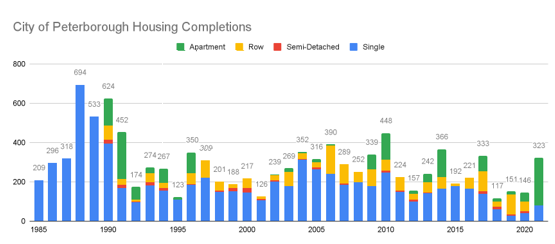
What has changed in the past 30 years?
Regulations
In the 1990s there were fewer provincial regulations for housing to be built. The provincial government provides a standard set of rules and guidelines that each municipality must follow for new housing. Each municipality also creates their own local by-laws.
Commenting agencies review all new home applications before approval. For example, conservation authorities enforce provincial legislation to ensure that local natural heritage and watersheds are protected. As new legislation is added, old rules often contradict new rules, creating unnecessary red tape.
Employees
Staffing levels at the City of Peterborough’s building and planning departments have been a longstanding issue. The number of different builders has decreased, reducing competition. Thousands of skilled trades workers are close to retirement and there are shortages of tradespeople.5 There are many opportunities for young people to get into skilled trades, municipal planning, and engineering.
Rising Costs
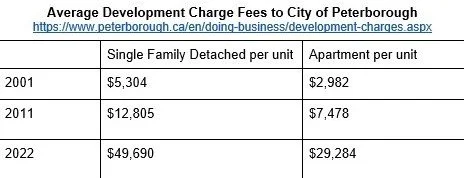
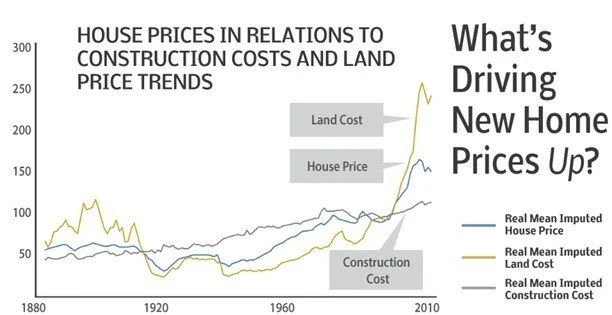
New housing includes fees to pay for needed infrastructure to go along with growth. Those fees have increased by 880% in the past 20 years in Peterborough, and the municipal infrastructure, like roads, has not kept pace. Also, the cost of land is now higher than the cost to build a new home.
Inefficient Municipal Processes
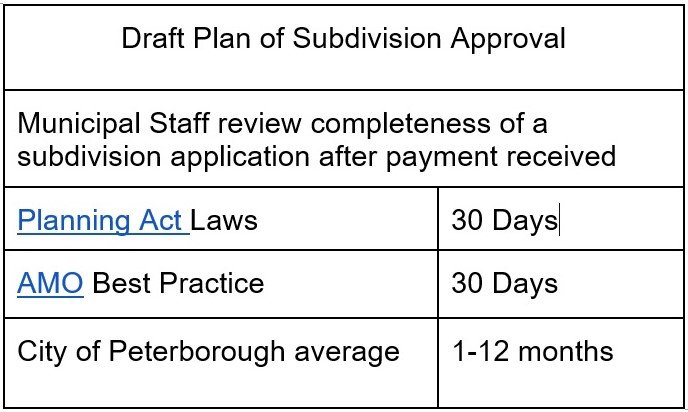
Delays stem from both provincial and municipal regulations. Municipalities control housing timelines through the official plan, zoning by-laws, variances and building permits required for new housing.6
Peterborough is in an excellent position to make big changes with provincial funding from the Steamline Development Approval Fund.7 Bill 109 allows the professional planning staff at City Hall to approve site plans, as per the City’s Official Plan without redundant council votes.8
Community
The “as is” approach to housing has seen a decline in units available and lack of growth in Peterborough. There are opportunities for improvement to create a vibrant more affordable community in the City of Peterborough. Everyone needs to agree that we need more housing in Peterborough and also take action to create more housing. Collaboration is needed so our children can afford to live in Peterborough when they grow up.
Endnotes
1. https://storeys.com/peterborough-ontario-overvalued-housing-market/
2. https://en.wikipedia.org/wiki/List_of_census_metropolitan_areas_and_agglomerations_in_Canada
3. https://files.ontario.ca/mmah-place-to-grow-office-consolidation-en-2020-08-28.pdf
4. https://www.peterborough.ca/en/doing-business/resources/Documents/Official-Plan/2021-10-22-Draft-New-Official-Plan---Tracked-Changes-Version---Accessible.pdf
5. https://energynow.ca/2021/11/700000-tradespeople-set-to-retire-this-decade-10000-worker-deficit-predicted/
6. https://papers.ssrn.com/sol3/papers.cfm?abstract_id=3472145
7. https://pub-peterborough.escribemeetings.com/filestream.ashx?DocumentId=34244
8. https://www.ola.org/en/legislative-business/bills/parliament-42/session-2/bill-109
Content provided by the Peterborough and the Kawarthas Chamber of Commerce.
Engage with us on social media on Twitter, Instagram, Facebook and Tiktok. Write to us at tips@ptbocanada.com. Sign up for PTBOBuzz newsletter here.
Voice of Business: Federal Sectors Need To Improve Public Notice
/Roadwork is a necessary part of investing in our infrastructure.

It’s an inconvenience for commuters and travelers, but it can have big implications for the local business community. Providing adequate notice, communication, and consultation are key to minimizing community impact and business disruption.
Most road closures and traffic restrictions are conducted by municipal or provincial governments, which have strict rules around providing notice to neighbouring residents and business, federal projects have few rules and what’s in place is largely inadequate.
For this reason, Peterborough and the Kawarthas Chamber of Commerce has a policy resolution before the Canadian Chamber of Commerce titled Increasing Public Notice and Consultations for Federal Projects. This resolution will go to the CCC members at the annual general meeting in October and, if approved, will become part of the national advocacy effort for the next three years.
Whether it’s for a few hours, days, or even years, these projects have big implications for neighbouring residents and businesses.
For projects that disrupt traffic for a few hours or days, having adequate notice allows businesses to reschedule staff, adjust their advertising and marketing, and alter their sales programs. This can save thousands of dollars per day by facilitating prudent spending.
Projects that require significant traffic disruptions for months or years can cause major issues for affected businesses to the point that some will end up closing for good. Proper planning and communication can help businesses manage things like buying the appropriate amount of inventory, maintaining adequate staffing, and sourcing other opportunities to reach their customers.
Regardless of the length of the street closure, providing the public with ample notice allows them to better understand what is happening and plan their visits to local businesses accordingly.
Most construction projects require extensive consultation with local municipalities to provide detour options and provide appropriate notice to the public well ahead of any work being done.
However, federally administered and/or regulated projects don’t have those same requirements and often minimal communication and consultation are provided to neighbouring residents, businesses, and municipalities. Businesses in Peterborough have experienced multi-day closures of busy streets with less than 24 hours notice for rail crossing work. Businesses and residents were provided one month notice and minimal municipal consultation for the replacement of a bridge by Parks Canada on one of the main routes into the City of Peterborough that took nine months to complete.
Transport Canada requires railway work to follow the Notice of Railway Works Regulations, but that only requires notice to a limited group, including the municipality and property owners immediately abutting land at the crossing. While it does require 60 days notice, obligations to the neighbouring community are limited and there are no requirements to provide detours.
All non-rail projects aren’t regulated by Transport Canada since they are deemed a business practice. The various government ministries, departments and services are left to establish their own standards, which have proven difficult to access.
There are times when work must be done on an immediate basis with minimal prior notice due to emergencies, but most projects involve months, if not years, of planning to budget, tender, and schedule infrastructure work.
Our recommendations are that the government of Canada:
Require federal agencies and federally regulated sectors to communicate publicly the intention to undertake upcoming construction projects that impact transportation routes as early on in the planning process as is practical
Require federal agencies and federally regulated sectors to provide notice that includes all nearby residents and businesses, not just those immediately adjacent to the project:
a) a minimum of 30 days notice for road closures that are seven days or less
b) a minimum of 90 days notice for road closures expected to last more than seven days
Require federal agencies and federally regulated sectors to thoroughly consult with municipalities and contribute resources toward detour options
Improving communication and consultation will go a long way to helping local businesses and reducing frustration for everyone involved. Scheduled infrastructure improvements that involve closing streets should provide at least as much notice as what is expected when organizing a parade.
Content provided by the Peterborough and the Kawarthas Chamber of Commerce.
Engage with us on social media on Twitter, Instagram, Facebook and Tiktok. Write to us at tips@ptbocanada.com. Sign up for PTBOBuzz newsletter here.
Voice of Business: We Need An Engaged and Informed Community
/Municipal election campaigns are officially underway!

The deadline for all prospective candidates to file their papers was Friday, August 19. Official candidate lists will filter out in coming days — all in preparation for election day on Oct. 24
As a Chamber of Commerce, our role is to be non-partisan advocates for the local business community.
We have an ambitious plan to engage the community and candidates this fall by hosting nine election debates — an in-person mayoral debate in the city and eight Zoom debates in the townships of Peterborough County.
• Monday, Sept. 26 5:30 – 7:00 pm — Township of Douro-Dummer (via Zoom)
• Monday, Sept. 26 7:30 – 9:00 pm — Township of Asphodel-Norwood (via Zoom)
• Tuesday, Sept. 27 5:30 – 7:00 pm — Township of Otonabee-South Monaghan (via Zoom)
• Tuesday, Sept. 27 7:30 – 9:00 pm — Selwyn Township (via Zoom)
• Wednesday, Sept. 28 5:30 – 7:00 pm — Township of Havelock-Belmont-Methuen (via Zoom)
• Wednesday, Sept. 28 7:30 – 9:00 pm — Township of Cavan Monaghan (via Zoom)
• Thursday, Sept. 29 5:30 – 7:00 pm — Municipality of Trent Lakes (via Zoom)
• Thursday, Sept. 29 7:30 – 9:00 pm — Township of North Kawartha (via Zoom)
• Thursday, Oct. 6 7:00 – 8:30 pm — City of Peterborough mayoral debate (in person and streamed on YouTube)
Ward councillor candidates in the City of Peterborough will be provided with a questionnaire on local issues and we’ll be sure to share their feedback online.
The last two years have shown the power of streaming events like political debates online. Our provincial election debate in the fall garnered 1,400 YouTube views and our federal election debate the year before had 3,200 views. And that’s just YouTube. The debates were posted on other social media channels and broadcast on YourTV. We’re reaching more people than ever before.
We will also be hosting an election page at pkchamber.ca with the latest information on local candidates, issues and events.
You can also find municipality-specific election information here:
City of Peterborough
Township of Asphodel-Norwood
Township of Cavan Monaghan
Township of Douro-Dummer
Township of Havelock-Belmont-Methuen
Township of North Kawartha
Township of Otonabee-South Monaghan
Township of Selwyn
Municipality of Trent Lakes