
Peterborough Blogs



Voice of Business: Creating a National Strategy Regarding Healthcare Credentials
/Every province and territory in Canada is struggling to find enough healthcare professionals, adding strain on already overburdened systems.

This is impacting access to effective and efficient healthcare, limiting labour mobility and increasing lost time and productivity across all sectors. As we struggle to train enough workers domestically, barriers to labour mobility in the healthcare sector are keeping skilled workers away. The fragmented and archaic foreign credential recognition processes across the country are leaving qualified newcomers working in areas outside of their expertise. We need a national strategy regarding accreditation barriers in the healthcare sector that addresses interprovincial and international qualifications.
The Peterborough and the Kawarthas Chamber of Commerce and Fredericton Chamber of Commerce have teamed up on a policy resolution submitted to the Canadian Chamber of Commerce (CCC) at the October convention, urging the federal government to take action on this issue. Policy resolutions are one way for Chambers to work together to create change. If approved by the CCC members, this resolution would become part of the CCC’s advocacy efforts for the next three years.
Systemic healthcare deficiencies across Canada are holding back our workforce and our economy.
The OurCare national survey showed an estimated 6.5 million Canadians are without a family doctor. In Ontario alone, the Ontario College of Family Physicians estimates 15 per cent of the population is without a family doctor and expects that to increase.
Workers who do not have access to primary healthcare through a family doctor are left to piece together solutions for their healthcare needs. The demands on hospitals and a lack of available workers have led to lengthy ER wait times, contributing to worse health outcomes, more time spent trying to access healthcare and more lost time in the workforce.
A shortage of accredited workers is also holding back private sector healthcare providers from meeting the needs of Canadians and supplementing the public system.
In 2020, a Statistics Canada report noted skilled newcomers are under-used in the healthcare sector with 47 per cent of them either unemployed or underemployed in non-healthcare jobs needing only a high school education.
The Government of Canada already provides funding to governments and organizations through the Foreign Credential Recognition Program (FCRP) to support foreign credential recognition in Canada. These other organizations may include regulatory bodies, national associations and credential assessment agencies. Every year, Canada’s Foreign Credential Recognition Program invests roughly $27.1 million through agreements with provinces and territories, regulatory bodies and other stakeholders to help support the labour market integration of skilled newcomers.
While these measures may help, this piecemeal approach will also further exacerbate provincial and territorial variance as programs and projects are implemented on a case-by-case basis. These investments also demonstrate that the federal government accepts that it has a role to play in credential recognition, despite most credentialling bodies being provincial in nature.

Content provided by the Peterborough and the Kawarthas Chamber of Commerce.
Engage with us on social media on Twitter, Instagram, Facebook and Tiktok. Write to us at tips@ptbocanada.com. Sign up for PTBOBuzz newsletter here.
Voice of Business: Government Loan Repayment Post Cabinet Shuffle
/Repaying loans is creating another financial challenge for our local business community.

According to the Canadian Broadcasting Corporation (CBC), The Bank of Canada recently increased interest rates and now the Canada Emergency Business Account (CEBA) repayment deadline is looming. Many small business owners are facing more debt and more barriers to the long road of recovery from the pandemic. As we previously stated in our March Voice of Business column, it cannot be stressed enough that CEBA loan repayment is still a challenge for many small businesses. Recently, the Canadian Chamber of Commerce and 280 industry associations penned a letter to Minister Freeland highlighting the number of businesses that may not survive in the long term due to ever-growing debt. According to the letter, 49 per cent of small businesses’ revenues are still below normal, and approximately half of tourism-based businesses may not survive in the next few years.
“…not all businesses have their heads above water yet: they’re facing extreme inflation, unreliable supply chains, and the tightest hiring market in a generation. They’re just asking for more time to pay the government back.”
- Matthew Holmes, Senior Vice President of Policy and Government Relations, Canadian Chamber of Commerce
In another turn of events, the federal government announced a cabinet shuffle on July 26. In this change, there will be a new Minister of Small Business, MP Rechie Valdez. Valdez is a former small business owner herself. We look forward to seeing what she can bring to the table. In the swearing-in ceremony, she stated she would like to make the small business its own portfolio.
The need for an extension has already come up in the past. In 2021, the Peterborough and the Kawarthas Chamber of Commerce authored a Policy Resolution for the Canadian Chamber of Commerce calling on the federal government to:
Extend the deadlines for repayment of the Canada Emergency Business Account program by two years.
Make the forgivable portion of the loan available to all businesses that continue to have operations impacted by ongoing COVID-19 public health restrictions throughout 2021.
Allow businesses that continue to have operations impacted by ongoing COVID-19 public health restrictions in 2021 to be exempt from incurring interest prior to the balance of their loan being due.
With the deadline to receive partial loan forgiveness approaching in approximately 5 months, it is imperative that those who can repay their loans do so and return those funds back to government coffers. We can ease the decision for the government to extend the loan repayment windows for the businesses that are struggling the most. We have a new Minister of Small Business, which means now is the time to remind the government that not all businesses have recovered and are in a position to pay back their debts.
While most of the restrictions and challenges of the pandemic are over, we are still seeing the lasting impacts for the small business community. Peterborough and the Kawarthas’ economy depends on tourism and hospitality businesses, so let’s continue to work together to climb the ladder out of the pandemic slump still facing us today, hopefully with continued support from the federal government.
Content provided by the Peterborough and the Kawarthas Chamber of Commerce.
Engage with us on social media on Twitter, Instagram, Facebook and Tiktok. Write to us at tips@ptbocanada.com. Sign up for PTBOBuzz newsletter here.
Voice of Business: Passenger Rail Service One Step Closer
/Passenger rail service to Peterborough and beyond has cleared another stage toward construction.

Transport Canada announced on July 20 that the Request for Qualifications it issued back in April had concluded and three proponents were selected as eligible to bid on the upcoming Request for Proposals.
The project will link Toronto, Peterborough, Ottawa, Montréal, Trois-Rivières, and Québec City with regular passenger rail service on dedicated passenger lines. It will require hundreds of kilometres of new track, refurbishment of old rail beds, new or improved crossings at every road it crosses, agreements with property owners, new stations, and a lot of planning. Creating a proposal for a project of this scale will require significant resources, which is why each of the three proponents are conglomerates made up of large construction and transportation industry companies.
The following groups have been invited to move to the Request for Proposals (RFP) stage:
Cadence (CDPQ Infra, SNC-Lavalin, Systra Canada, Keolis Canada)
Intercity Rail Developers (Intercity Development Partners, EllisDon Capital, Kilmer Transportation, First Rail Holdings, Jacobs, Hatch, CIMA+, First Group, RATP Dev Canada, Renfe Operadora)
QConnexiON Rail Partners (Fengate, John Laing, Bechtel, WSP Canada, Deutsche Bahn)
Next up will be one of the most exciting phases in the project: Request for Proposals. Expected to launch this September, proponents will be expected to draw up their plan to meet the goals of VIA HFR and Transport Canada with a technically and commercially feasible solution that includes both a business and management plan. The proposals should answer a lot of the big questions about this project, including cost, where the lines will run, whether there will be high-speed sections, construction timelines, whether any additional towns/cities will get a stop, where the line will connect to Toronto, and whether the lines will twin alongside freight and include much-needed freight line refurbishment.
Additionally, the project will be required to meet reconciliation goals, as per Transport Canada:
“Advancing reconciliation with Indigenous Peoples is a priority for the Government of Canada, and this is why early engagement with Indigenous communities is already underway. As part of the RFQ process, respondents were required to demonstrate their capacity to work with the government to create mutually beneficial, socio-economic development opportunities for Indigenous Peoples. Indigenous reconciliation is critical to the success of the HFR project and will be integrated in all phases of the project.”
The government expects to evaluate the proposal submissions in the summer of 2024. Following that, a case will be made to our federal government to fund it. Considering the years and hundreds of millions of dollars that will have already been spent at that point, it should be a choice between different business models and levels of service. Ideally, the business plan will show a high return on investment. After all, VIA’s big push for this project and its first dedicated passenger tracks is that they will be able to provide a higher level of service, which should equate to a much higher return on investment and push the crown corporation toward profitability.
As well, this project promises to move us forward in fighting climate change. The proposals should lay out a case for the amount of emissions they will help us cut while improving intercity connectivity. The rail network should be electric (or at least almost all electric), providing people with sustainable and environmentally-friendly transportation.
We still have a long way to go before passenger trains will stop in Peterborough, but we have come a long way in the last few years. If you want to read up a bit more on the history of how we got here, check out our Voice of Business column from March 1.
Content provided by the Peterborough and the Kawarthas Chamber of Commerce.
Engage with us on social media on Twitter, Instagram, Facebook and Tiktok. Write to us at tips@ptbocanada.com. Sign up for PTBOBuzz newsletter here.
Voice of Business: Labour Market Shows Signs of Improvement
/Canada’s labour crunch is showing signs that it’s beginning to ease up.

Labour data from the Canadian Chamber of Commerce Labour Force Survey June 2023 shows a slight increase in unemployment, gains in job growth in Ontario, and the slowing of wage growth.
Marwa Abdou, Senior Research Director at the Canadian Chamber of Commerce, states:
“Canada’s labour market is turning a corner with June’s data. Coming in at the highest level in over a year, Canada’s unemployment rate edged up to 5.4%. We’re also seeing average hourly wages coming off the boil, with their slowest growth in over a year.
However, the headline jobs number was strong, exceeding market expectations with a gain of 60K jobs (vs. 20K consensus), driven by full-time employment.
Overall, the market is showing signs of strength and resilience, although wage growth is moderating while still remaining high.”
Last summer, unemployment hung at a near-record low of 4.9 per cent. The jump to 5.4 per cent represents a 0.2 per cent increase from May and the highest level in over a year.
Meanwhile, the number of people working is increasing with a gain of 60,000 jobs. This job growth comes with an increase in full-time employment. The Labour Force Survey notes that much of the job gains are among men with employment of women largely staying the same through June.
The biggest changes in jobs by sector are:
Wholesale and retail trade (+33K)
Manufacturing (+27K)
Health care and social assistance (+21K)
Transportation and warehousing (+10K)
Construction (-14K)
Education (-14K)
Agriculture (-6K)
While the jobs gains are welcome news, especially in the wholesale and retail trade sector, the decline in construction, education, and agriculture will be a struggle in those sectors.
Only Ontario (+56K), Nova Scotia (+3.6K), and Newfoundland and Labrador (+2.3K) saw increased employment. Prince Edward Island saw a decline of 2,400 jobs while the remaining provinces stayed relatively the same.
According to our local Workforce Development Board Eye on the Labour Market – June 2023 report, the top positions being posted by local employers in June were:
University professors and lecturers
Retail salespersons
Other customer & information services representatives
Home support workers, housekeepers & related occupations
Food counter attendants, kitchen helpers and related support occupations
Retail and wholesale trade managers
Social and community service workers
Cooks
Administrative assistants
Construction Trades helpers and labourers
Unfortunately, labour growth is one of the factors cited by the Bank of Canada in its recent decision to further hike its Overnight Lending Rate by 0.25 basis points to five per cent. Sitting at 3.4 per cent in May, Inflation is down from its peak, but not as low as the bank would like.
While last month’s labour data is largely positive for most businesses, the current economy and labour market are impacting different sectors and business models disproportionately. Rising interest rates and inflation are putting added pressure on businesses, but hopefully increased access to labour will help ease that burden.
Content provided by the Peterborough and the Kawarthas Chamber of Commerce.
Engage with us on social media on Twitter, Instagram, Facebook and Tiktok. Write to us at tips@ptbocanada.com. Sign up for PTBOBuzz newsletter here.
Voice of Business: Home Stretched: Tackling Ontario's Housing Affordability Crisis Through Innovative Solutions and Partnerships
/The cost of housing is impacting communities of all sizes across Ontario. It’s limiting the buying power of households, impacting businesses’ ability to attract and retain talent, and exacerbating homelessness rates throughout the province.
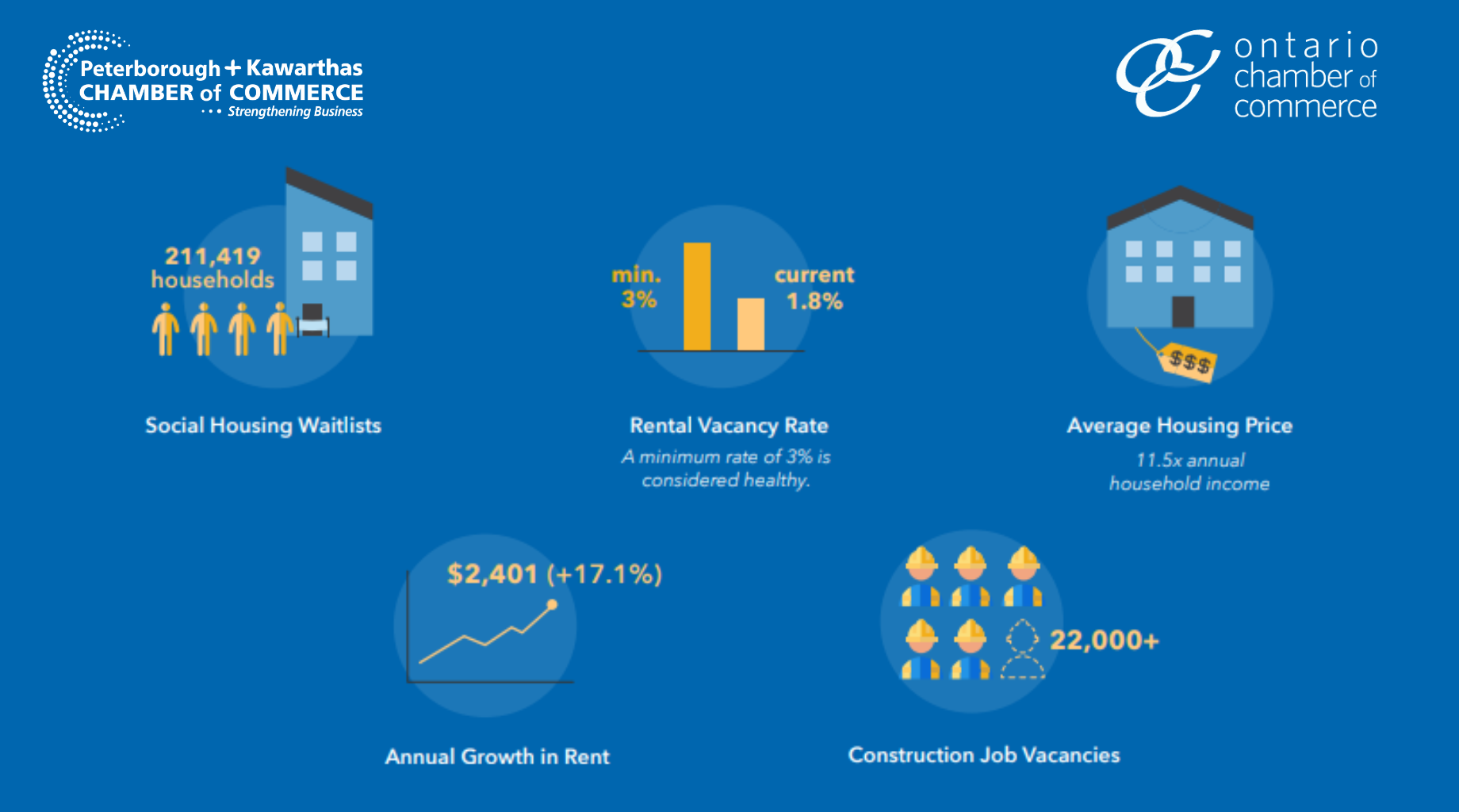
The Ontario Chamber of Commerce (OCC) recently released Home Stretched: Tackling Ontario's Housing Affordability Crisis Through Innovative Solutions and Partnerships, outlining opportunities for the private, public, and non-profit sectors to explore innovative partnerships and approaches to address housing affordability and supply, and recommendations to build on successful models. The OCC report is in partnership with Desjardins, Cadillac Fairview, and the Federation of Rental-housing Providers of Ontario. It builds on research from a series of regional housing affordability roundtables with a diverse range of housing sector stakeholders.
The Government of Ontario has committed to building 1.5 million new homes by 2031 to help mitigate this crisis. This goal will require strategic action and significant collaboration across sectors and all levels of government. It will require the public, private and non-profit sectors to work together.
The housing crisis in Ontario has reached a critical point, with significant challenges related to both affordability and supply. Peterborough has not been immune to these pressures, as rising housing costs are impacting many of our businesses' ability to attract and retain labour. At the same time, higher housing costs leave less income available to spend on other goods and services, which directly affects our community’s long-term economic growth.
The executive summary from the report sums up a lot about the current situation:
While distinct, housing supply and affordability challenges are mutually reinforcing: as mid-high income earners are priced out of the real estate market, they are increasingly occupying market rental housing for longer, contributing to low vacancy rates and rising rental rates. This puts additional downward pressure on the limited supply of more affordable, non-market housing options, where waitlists can reach up to 12 years across the province, further compounding the homelessness crisis. At the same time, social and economic pressures, such as inflation and supply chain challenges, are contributing to rising costs for housing development (which has not kept pace with demand), while hindering mobility along the housing continuum.
The OCC report highlights some key statistics:
211,419 households on social housing waitlists
Provincial rental vacancy rate of 1.8 per cent (3 per cent is considered healthy)
The average house price is now 11.5 times annual household income
Rent has increased by 17.1 per cent over the last year, now sitting at an average of $2,401
22,000+ construction job vacancies
68 per cent of organizations in Ontario continue to report labour shortages in their respective industries
1.85 million additional units would be needed in Ontario beyond what is already being built or in the pipeline to restore housing affordability
The OCC policy brief provides all levels of government and industry with recommendations under the following themes: Labour and Demographics, the Housing Continuum, and Infrastructure and Land Use Planning.
The report has 34 recommendations, including:
Continue to establish and deliver on inclusive workforce development and immigration strategies to increase the labour pool needed to build more housing.
Incentivize the development and preservation of affordable housing options along the continuum, including purpose-built rentals, missing middle, student, non-profit, cooperative, and supportive housing.
Support the development and expansion of innovative technologies, data tools, retrofitting, building conversions, as well as mixed-use and climate-resilient green housing.
Housing is at the root of a lot of issues we’re facing in Ontario. It’s contributing to the rising cost of living, limiting labour mobility, and leaving people without homes altogether. For the sake of our communities, we need to encourage our governments to work with the private and non-profit sectors to enact a wide range of policies to address our current housing crunch. The Home Stretched report is a good place to start.
Content provided by the Peterborough and the Kawarthas Chamber of Commerce.
Engage with us on social media on Twitter, Instagram, Facebook and Tiktok. Write to us at tips@ptbocanada.com. Sign up for PTBOBuzz newsletter here.
Voice of Business: The Availability, Accessibility and Accuracy of AI Is Changing the Business Landscape
/Technology is continually changing business.

Over the last year, artificial intelligence (AI) has grown in its ability and accessibility to the average person and business. It has caused us to re-think what can be automated, how we shape our customer experience, and how we manage our teams.
Many of us have typically viewed automation from a more physical sense. We have machines that weld, paint, and drive heavy equipment by themselves. Now, it seems technology is coming for the creative tasks. At a recent event with local manufacturers and supply chain businesses, automation was a popular topic with a lot of it focused on artificial intelligence taking on administrative and creative work. AI is streamlining training, reporting, and administration. One manufacturing representative noted that there will always be jobs for people that work with their hands — it’s the office side of the business where jobs are being replaced by machines.
Chatbots are quickly becoming a regular point of engagement for customers as businesses are looking to save money and improve efficiency. In a time when many businesses are operating with fewer staff than they would like due to challenges attracting talent — efficiency is everything.
Hootsuite put together an article for Digital Main Street called 10 Ways an AI Customer Service Chatbot Can Help Your Business. Their suggestions for including AI Chatbots in a business include:
Provide customer support in multiple languages
Answer repeat FAQs and save your team time
Gather customer demographic information
Personalized shopping support
Convert deals and upsell
Anticipate trends
Book in-store appointments
Improve customer wait times
Improve customer retention
Provide a consistent user experience
The Hootsuite report includes the benefits of using AI for customer support, describing it as: “You can think of AI as one of your star customer support team members — they’re always available, never complain, and are hyper-organized”. Ultimately, AI allows you to support your customers at all hours while meeting their accessibility needs and language of choice, allowing your team to focus on other tasks.
The name getting a lot of the attention these days is ChatGPT, but it’s a quickly growing sector with a lot of options and different companies looking to offer the latest and greatest innovation. ChatGPT was recently purchased by Microsoft and included as part of their search engine, Bing, for free.
We asked the AI chatbot on Bing how businesses can use AI and it came up with its own explanation:
“Artificial Intelligence (AI) has become an essential tool for businesses in recent years. AI can help businesses automate and optimize routine processes and tasks, which can save time and money. It can also help businesses make faster decisions based on outputs from cognitive technologies. AI can help businesses improve their productivity and operational efficiencies by reducing the time employees spend performing a task. This can lead to more work being done in less time, enhancing the company’s overall productivity.
AI can also help businesses reach a larger audience and establish long-term customer relationships. This can create customer loyalty, leading to a continuous revenue flow for the company. With time, AI is getting more sophisticated and powerful. So, it’s high time you ditch your legacy systems and integrate AI into your business operations.
However, it is important to note that there are risks associated with AI as well. Mistakes can cause massive damage to a company’s infrastructure and reputation…Cyberattacks are extremely common today, so businesses need to be aware of the vulnerability of their systems to cyberattacks.”
The availability, accessibility, and accuracy of AI is changing the business landscape. Businesses looking to tap into better use of technology can get free help from our Digital Main Street team. Get in touch with the Chamber and we’ll set you up with an expert.
Content provided by the Peterborough and the Kawarthas Chamber of Commerce.
Engage with us on social media on Twitter, Instagram, Facebook and Tiktok. Write to us at tips@ptbocanada.com. Sign up for PTBOBuzz newsletter here.
Voice of Business: We Need to Move Ahead Together
/It was refreshing to see three local mayors having an open and candid discussion on local issues last Friday at the Chamber’s Three Mayor’s Breakfast at Lakefield College School.

The Chamber hosted the mayors of the townships of North Kawartha, Selwyn, and Douro-Dummer for a moderated discussion on local business and community issues. As part of the discussion our audience submitted a steady flow of great questions that pushed the conversation ahead on key topics.
Finding common ground
Most of us can agree on some key local business and community issues. We know our region needs more housing and at a price our local workforce can afford to rent and buy. Businesses in almost every industry are struggling to attract the skills and experience they need from the workforce and we need to get innovative with technology and how we attract and support talent. We need to cut our carbon footprint and preserve the natural environment we love about Peterborough and the Kawarthas.
The layers of government
One thing the township mayors made clear is that though they may punch above their weight, their size comes with limitations. It’s going to take all levels of government and their affiliated agencies working together to have the most effective and efficient growth.
We have quite a few layers of government locally. We have Townships, which are part of the County which surrounds the City – both of which are overseen by the Province. We have the federal government, multiple First Nations governments, and school boards. Together, we have close to 70 elected representatives in our region.
Just in terms of improving our transportation infrastructure, we have township roads, county roads, and provincial highways.
Local issues
We can’t have governments working in isolation on important and multifaceted issues. There are a variety of housing needs and different challenges across Peterborough and the Kawarthas, but we need our governments to work together to find efficiencies in the process, attract investment to our region, and collectively deal with some of the barriers.
Healthcare is largely provincial in the mandate but we have municipalities actively working to create healthcare facilities and attract medical professionals because our communities need these services to meet the needs of local residents.
There is growing discussion about regional bus service through Peterborough and the Kawarthas. We have a pilot project called The Link, which is an example of a successful partnership between the Province, Selwyn Township, Curve Lake First Nation, Community Care Peterborough, and the City of Peterborough. Hopefully this service can be expanded further to help more people get to work and appointments.
Employment lands have been an ongoing issue for a while. We are missing out on opportunities because we don’t have enough designated and serviced employment ready to go for prospective businesses to
consider for large industry opportunities. It’s unrealistic that anyone local municipality is going to be able to satisfy this need on their own. We need to move ahead on this together with a regional mindset.
Investing together
Many of these issues are intertwined. When we have attainable housing, access to healthcare, and a car-free way to get to work, we can attract more people to our workforce.
Our communities are growing. How we grow takes leadership, intentional investment, and cooperation with all levels of government.
Content provided by the Peterborough and the Kawarthas Chamber of Commerce.
Engage with us on social media on Twitter, Instagram, Facebook and Tiktok. Write to us at tips@ptbocanada.com. Sign up for PTBOBuzz newsletter here.
Voice of Business: Investing In Mental Health Builds Stronger Businesses
/The workforce crunch has many employers looking at whatever opportunities they can to do more with less, from automation and technology to retraining and upskilling.

One area we can invest is in the mental health of our teams. The last few years have left a lot of people in a situation where they aren’t at their best. The workplace has come a long way in terms of how we talk about mental health and support workers through their journey, but there’s more progress to be made.
The Ontario Chamber of Commerce (OCC) and Medavie recently announced a new research project aimed at accelerating health and economic solutions to tackle the surge in mental health challenges since the onset of COVID-19, known as the mental health “echo pandemic.” The Peterborough and the Kawarthas Chamber of Commerce, the OCC, and many other business-focused organizations across the province are committed to supporting investment in the health and well-being of Ontarians, adding to the overall resilience of the economy.
As per the OCC:
With mental health challenges and illnesses increasingly impacting individuals and communities, the OCC recognizes the urgent need for comprehensive solutions. Through this policy project, the OCC will delve into the socioeconomic impacts of the mental health crisis, from rising health care costs to lost productivity, absenteeism, and presenteeism. The goal is to generate actionable insights and policy recommendations that can guide policymakers, businesses, and the health sector in addressing Ontario’s mental health challenges.
“Mental health is a critical component of overall health, with significant implications for individuals, businesses, and the economy,” said Rocco Rossi, President and CEO, Ontario Chamber of Commerce. “By conducting research and collaborating with experts, we aim to identify effective strategies that support mental health, promote health system resilience, and drive economic prosperity in Ontario.”
Building on our previous work to tackle the mental health action gap, the OCC is proud to have the support of Medavie, a leading health solutions partner, in this vital project. Over the next several months, the OCC will lead a series of consultations with members and mental health stakeholders to identify specific obstacles, initiatives, and policy recommendations to address mental health and addictions challenges. A policy brief will be published in Fall 2023 as part of our Policy Primer Series, with key takeaways and recommendations for government and industry.
“We’ve seen the lasting impacts the pandemic has had on the mental health of individuals and communities,” said Matthew Crossman, Vice President, Operations, Medavie Health Services. “As part of our mission to improve the wellbeing of Canadians, we focus on increasing awareness of mental health and addictions supports and services while aiming to ensure people have access to the care they need, when and where they need it.” We are proud to partner with the Ontario Chamber of Commerce on this initiative in support of the people, businesses and communities we serve.”
We are inviting businesses, organizations, and people passionate about mental health to support this new research project. We are looking to create change in the workplace and promote a supportive policy environment that prioritizes mental wellness. To learn more or get involved, contact Sara Beyer, Senior Policy Analyst with the OCC, at sarabeyer@occ.ca.
Outside of this OCC initiative, we have numerous resources in our community for people and businesses to work with to address our mental health challenges. People who are getting the support they need will be happier, more reliable, and more efficient. It’s better for our communities and families while helping local businesses thrive.
Content provided by the Peterborough and the Kawarthas Chamber of Commerce.
Engage with us on social media on Twitter, Instagram, Facebook and Tiktok. Write to us at tips@ptbocanada.com. Sign up for PTBOBuzz newsletter here.
Voice of Business: Systemic Barriers Are An Issue For LGBTQ2+ and BIPOC Business Owners
/
When you think about starting a business, you likely consider many of the same factors as every other business owner; What are your goals, where should you locate, what will you offer, who will you hire? Most importantly though, you will think, how will I fund this?

It’s a question every business owner asks when planning their business. Many entrepreneurs don’t think twice about applying for grants, loans, and other sources of business funding to get started. For those who identify as LGBTQ2+ or BIPOC, however, things aren’t quite so clear. There is a problem in our business world that is systematically creating barriers for business owners that are visual minorities or openly queer; funding is just one of these barriers.
According to a study done by the Canadian Gay and Lesbian Chamber of Commerce and Deloitte, 20 per cent of the members of the LGBTQ2+ community face business scaling challenges with financing as one of the top items on their list of barriers. In the same survey, 62 per cent of respondents stated that they would not disclose their LGBTQ2+ identity in official materials or to stakeholders.
For those who are BIPOC, there is even less opportunity to hide your identity and therefore even more barriers to business. Another study conducted by The Canadian Black Chamber of Commerce found that 35 per cent of respondents never take advantage of funding programs presented, with eligibility (36 per cent), lack of time/resources (16 per cent), and less than 10 staff members (14 per cent) listed as the main reasons they never apply.
Combined, the LGBTQ2+ and BIPOC communities account for roughly 25% of the Canadian population. Together, they are huge contributors to our economic, social, and cultural societies. Preventing LGBTQ2+ and BIPOC businesses from opening or operating at their full potential impacts the community as a whole. These individuals offer so many talents, perspectives, and experiences that are not shared or experienced due to business barriers. When these groups suffer, we all do.
In order to address systemic discrimination, there are many things that need to occur. Two main objectives could be:
Ensuring that start-up funding is accessible and equitable
Providing more mentorship opportunities to LGBTQ2+ and BIPOC communities
What can small business owners do?
Promote diversity in your workplace
The next time you’re hiring, consider a candidate that falls into a marginalized group. Contact organizations like The New Canadian Centre, Trent Queer Collective, Curve Lake First Nations Employment Resource Centre, or the Nogojiwanong Friendship Centre to connect to candidates searching for local employment.
Address your own (un)conscious biases
Take a moment to reflect internally and address any race, ethnicity, age, gender, sexual identity and ability biases. Shift your perspective and look at things through their lens.
Practice mindfulness. Once you identify your biases, be more mindful in your decisions and thoughts.
Provide resources
Don’t just say you're inclusive; provide the resources to BE inclusive. Set a workplace discrimination policy that honours all races, religions, and identities and enforce it with your team. ○ Attend diversity training. We recommend EQU for DEI training and support.