
Peterborough Blogs



Voice of Business: OCC Calls For Forward Looking Investments in Budget 2024 Amidst Economic Challenges
/Guest Column from the Ontario Chamber of Commerce
In the wake of the Province’s Economic Outlook and Fiscal Review, Rocco Rossi, President and CEO, Ontario Chamber of Commerce (OCC), is calling on the Ontario government to prioritize strategic, long-term investments in the upcoming 2024 budget.

“Ontario’s business community continues to grapple with challenges ranging from labour shortages to inflation to broader economic uncertainty. In Budget 2024, the Ontario government needs to focus on measures that not only support immediate growth but also lay the groundwork for sustainable long-term economic expansion.”
The OCC’s membership encompasses a wide range of industries, each with its unique needs and challenges. However, there are crucial areas where the government’s focus in the 2024 budget can significantly impact all sectors. These include:
Investing in Workforce Development: To address critical labour shortages, investments to resolve skills mismatches are vital. These initiatives should be designed to close the gap between current workforce skills and the evolving demands of Ontario’s labour market.
Enhancing Infrastructure: Strategic investments in infrastructure, including transportation and digital connectivity, can boost immediate economic activity while supporting long-term growth. This includes expanding broadband access in rural and remote areas and upgrading public transit and road networks.
Fostering a Business-Friendly Environment: Implementing policies that reduce red tape and create a conducive environment for business growth is essential. This includes reviewing and streamlining regulatory processes, providing tax incentives for businesses looking to expand or relocate to Ontario and targeted support for indebted small businesses.
Supporting Innovation and Technology: Encouraging the adoption of new technologies and supporting innovation can help Ontario businesses remain competitive in a global market. This includes providing incentives for research and development and supporting technology-driven sectors.
“The OCC welcomes the Province’s commitments in its 2023 Ontario Economic Outlook and Fiscal Review across crucial policy areas, including housing, health care, investment attraction, workforce, and infrastructure, which will have positive implications for the economy. Notably, the new Ontario Infrastructure Bank (OIB) has the potential to unlock private investment in infrastructure, including affordable housing, which has been indicated as a top priority for the bank.”
The OCC remains committed to working collaboratively with the government and its members to advocate for policies that bolster the province’s economic health and ensure a prosperous future for Ontario.
The Peterborough and the Kawarthas Chamber of Commerce is an active and engaged member of the Ontario Chamber of Commerce.

Content provided by the Peterborough and the Kawarthas Chamber of Commerce.
Engage with us on social media on Twitter, Instagram, Facebook and Tiktok. Write to us at tips@ptbocanada.com. Sign up for PTBOBuzz newsletter here.
Voice of Business: Quality Data Takes Local Input
/Data is worth more than $100 billion globally, a figure that is quickly increasing.

That’s just the value of what we can directly monetize. Its value goes well beyond that, playing a critical role in life and business. We use data for everything from picking television shows to planning growth in our communities.
Good quality data can be priceless. The more detailed and the more local the information, the greater its impact. At the Chamber, we rely heavily on data to better understand business and economic challenges and create forward-thinking policy that will better position our business community for the future.
One way you can help is by completing the Ontario Chamber of Commerce (OCC) Business Confidence Survey. This annual survey of businesses across Ontario offers a benchmark on the business climate. It’s your opportunity to have your voice heard on the issues that matter most, including priorities for economic growth, labour shortages, technology, climate change, and confidence in the economy and your own organization’s success.
Data from the Business Confidence Survey is used in the OCC’s annual Ontario Economic Report and its advocacy on policy priorities for the year ahead. As well, chambers, boards of trade, and other organizations use that data to inform their understanding of the challenges and opportunities facing businesses.
The more local participation we have in the survey the more local the data we access. Otherwise, we are relying on data aggregated from across Ontario. Please take five minutes and complete the Business Confidence Survey here. The deadline for submissions is Nov. 21.
Nearly two years ago, the Canadian Chamber of Commerce (CCC) launched its quest to democratize data with the Business Data Lab (BDL). The BDL brings together the latest data from various sources to track evolving market conditions in user-friendly modules. It’s a powerful tool that makes accessing current data and analysis easy for businesses and organizations — and it’s free!
Last week, the CCC announced an expansion of the BDL Business Conditions Terminal. This tool offers up-to-date and historical data on:
Sentiment and outlook
Workforce
Business activity
Business dynamics
Financial conditions
Transportation and tourism
International trade
Environmental practices
It also includes an executive summary section offering a brief summary of each topic as well as a rating on its conditions.
Currently, the BDL is seeking renewed support from the federal government to keep this valuable tool functioning at its best. We have signed a letter urging the Government of Canada and the Honourable Rechie Valdez, Minister of Small Business, to continue supporting BDL's mission and tools.
Locally, we need you to subscribe and read our weekly newsletters to get the latest information and find opportunities to offer your input on Chamber initiatives and priorities.
Content provided by the Peterborough and the Kawarthas Chamber of Commerce.
Engage with us on social media on Twitter, Instagram, Facebook and Tiktok. Write to us at tips@ptbocanada.com. Sign up for PTBOBuzz newsletter here.
Voice of Business: Employment Lands Can’t Be Left Out of the Growth Conversation
/We desperately need more housing but it’s not good for our long-term sustainability to tackle the issue as housing at all costs.

The lack of housing opportunities is creating significant challenges and anxiety among businesses and our community as a whole. We have already become too expensive for some to live here and the problem seems to worsen.
Understandably, all levels of government are fixated on creating more housing — as they should be. But we need to make sure we don’t lose perspective of the vision our communities need for the future.
We need more employment lands to go along with our population growth or we risk becoming an expensive bedroom community.
Not only will servicing more employment lands build a stronger local workforce, but it offset the tax burden placed on homeowners. Commercial and industrial property owners in Peterborough pay 1.5 times the tax assessment rate of residential homeowners. While they desperately need basic municipal services like water and sewer — they use fewer services overall.
Municipalities can generate more revenue with fewer expenses while growing our local economy by servicing employment lands.
But we have essentially run out of serviced employment lands. There are a few pockets here and there, but local opportunities are slim. This is not just a City problem — we need to approach this as a region. There is a long history on this subject and it comes with a lot of baggage. It’s time to step back, look at the bigger picture, and come back to the negotiating table with all options as we try and work collaboratively to grow stronger as a region.
Currently, the City of Peterborough’s Official Plan is holding back much of these negotiations from even starting. Section 6.1.7 a) states:
Municipal utility services, sanitary sewer and water supply shall not be extended beyond the City boundaries, except when such infrastructure is to serve City owned facilities such as the Peterborough Airport.
It does go on to provide a couple exemptions but this statement is very limiting not to allow the municipality even to consider servicing land not within their boundaries or land they don’t own.
The City of Peterborough already has servicing agreements with the County and several townships on long-term care, emergency medical services, social services, and policing. Why is it a non-starter for water and sewer? Municipalities across Canada have water and sewer shared service agreements, enough so that the Federation of Canadian Municipalities offers a template service agreement for municipalities to use. Providing water and sewer service is expensive, but it’s not unreasonable to create a shared service agreement that covers the costs of this and provides financial benefits to all parties.
The message this section of the Official Plan sends is that if you’re planning to work out an agreement for serviced employment lands with the City of Peterborough, you’re really negotiating the terms of having your land annexed.
Annexation may or may not be part of the solution. The same goes for serving development outside city limits. The solution to our employment land shortage will have to be negotiated collaboratively between all parties with the understanding that it will benefit all, regardless of which municipality is collecting the tax revenue.
The City of Peterborough is undergoing a review of its Official Plan. Much of this review is focused on the back-and-forth between it and the Province to create more housing. One consequence of this back-and-forth is the potential loss of the few future serviceable employment lands within City limits.
Now is the time to rework the Official Plan and the Peterborough and Kawarthas Chamber of Commerce strongly urges the City of Peterborough to completely remove section 6.1.7. We advocate that the City and the County work together in good faith to create an employment lands agreement. This will open more opportunities to build housing, create more property tax revenue, and grow our local economy.
Content provided by the Peterborough and the Kawarthas Chamber of Commerce.
Engage with us on social media on Twitter, Instagram, Facebook and Tiktok. Write to us at tips@ptbocanada.com. Sign up for PTBOBuzz newsletter here.
Voice of Business: Small Businesses Lack Resources to Properly Address Mental Health In the Workplace
/We know we need to take care of our mental health but what does that mean for small and medium-sized businesses?

There’s a new report from the Ontario Chamber of Commerce (OCC) that takes a deep dive into how smaller businesses are struggling to properly address mental health challenges within their team and as business owners. The report is called Mind the Gap: Addressing the Mental Health and Addictions “Echo Pandemic” in Ontario. The report outlines 21 recommendations for both businesses and governments to tackle mental health in the workplace.
It seems like an understatement to say the COVID-19 pandemic left a big impact on us. It impacted our businesses, communities, neighbourhoods, family connections, economy, cost of living, etc. There is hardly a facet of our lives that wasn’t impacted. Some of these have returned to normal, others will continue to have a lasting impact.
We have been talking about mental health long before the pandemic, but it took a growing problem and pushed it to the point of crisis. As stated in Mind the Gap: “The crisis disproportionately impacted small and medium-sized enterprises (SMEs), frontline workers and underserved populations like Indigenous Peoples and northern, remote, and racialized communities.”
According to the report, 69 per cent of large businesses have a formal mental health strategy while only 33 per cent of small businesses have such a plan.
We no longer have the public health restrictions and the same anxiety about a spreading virus, but what we are left with is a mental health, “echo pandemic.” According to the OCC report: “In contrast to larger organizations, SMEs have limited capacity and resources to respond to the growing workplace impacts of the pandemic and have been placed at the forefront of the ensuing mental health crisis without adequate support.”
Mental Health is not just something for employees — many business owners are facing mental health challenges of their own. Some have watched their business that they have helped build for decades get decimated through the pandemic. They’ve taken on loans and the prospect of repaying them is becoming more daunting as the good times they hoped for haven’t materialized. Instead, they’re working more hours than ever as they struggle to hire while facing record inflation and more economic uncertainty. The life of an entrepreneur has always been one of stress and challenges, but the last few years have pushed this to a breaking point.
I encourage you to read through the recommendations in Mind the Gap. Without getting too much into the details, the suggestions for the business community include being strategic in how we invest in mental health in our workplace with progress that we can monitor and measure. We need a range of accessible mental health and addictions support programs for employees that reflect the diversity of our teams.
Our governments need to help make sure those mental health tools are available for businesses to tap into. It’s hard to refer people to services if the primary care sector doesn’t have the capacity to take it on. The report presents the need for additional supports to encourage more investment more in mental health including tax incentives and leveraging data to improve outcomes.
It’s time to move beyond talking about mental health and take strategic action that includes measurable goals toward a healthier workplace. It’s going to take action from both government and industry. We need to address the “echo pandemic” and mind the gap.
Content provided by the Peterborough and the Kawarthas Chamber of Commerce.
Engage with us on social media on Twitter, Instagram, Facebook and Tiktok. Write to us at tips@ptbocanada.com. Sign up for PTBOBuzz newsletter here.
Voice of Business: Local News; Guest Column from Jon Pole, President of My Broadcasting Corporation
/It’s a snowy Canadian morning. The wind is blowing, and the temperature is frigid. At the end of a long laneway is a little girl bundled up waiting for a school bus that’s not coming.

This is the heart of local news. Making sure the community is up to date, informed and safe.
There has been endless chatter about the internet regulation bills C-11 and C-18, but no matter the side of the argument you’re on, the bigger question is the future of local news.
Local news is more than just reporting on “the news.” It is knowing the community, the newsmakers and the real concerns on the street. To provide context to every story, you have to be an active member of the community. Simply put - you have to care. The leadership has to care. That’s how you build the trust to be “a news authority.” Big tech doesn’t impact your commitment to the community.
Suggesting that both Google and Facebook don’t care about our community or if we’re informed may not be perfectly accurate but it is not a huge stretch either. Have they run a food drive, showed up at the parade or been at a chamber event? No, of course not, and to be fair, that’s not their business model. It is however the job of the Canadian News media (if they want to be trusted by the community they serve).
Google and Facebook have jumped into the Canadian advertising landscape. Some reports show that Google and Facebook are taking half of all ad dollars spent. Last I checked, in Canada we are capitalists. Business landscapes change. Technology changes. How does the phrase go? “If you can’t stand the heat, get out of the kitchen.” Broadcasters who continue to support their communities with news and information are doing just fine. Radio doesn’t specifically need Facebook or Google to survive. Social platforms and Search are tools to market our brands (no different than any business), but they certainly don’t define us, nor do we have to use them. I know why the government is in this fight, but at the risk of offending some folks in Toronto and getting the Chamber in trouble, I will just say – I don’t feel threatened by Facebook and Google, and our teams have done a fine job using them, and a fine job not having access to them. They don’t impact on our business any more or less than our other competitors.
I believe the news has to be available where people are, which includes Google and Facebook. More importantly, no matter what the platform or delivery channel, the product has to be good and add value to the audience. Trust is not given by the consumer, it is earned.
Times change. Good operators that care about the community adapt and change. It can be hard in business to swing the ship, but change doesn’t mean you throw in the towel. I look at the August quarterly report from Yellow Pages Limited and see revenue of $62 million, their EBITDA for the quarter was 35% of revenue, their cash balance was $65 million and they’re paying dividends. While this may be dramatically different than 1985, that’s still a pretty good business. Heck, I didn’t know they were even still around! The point is, sometimes the world forces you to change the game plan. You either adapt or die.
Radio used to own school bus cancellations. That little girl at the end of the lane was our responsibility.
Today, we still do cancellations, but Facebook, email blasts, and texts also provide the information. That’s okay with me, because at the end of the day – we don’t want that little girl out there freezing. While radio may have lost that sole ownership of bus cancellations, did the community suffer? Not at all.
The good news is, there are still endless stories that we can cover, investigate and report that the community cares about as much. It’s our privilege to do it. It’s our job to do the work and reinvent. Google and Facebook won’t impact our results, our drive or our coverage. While the intentions of C-11 and C-18 are to help Canadian media, I’m not sold they address the real problem.
Guest Column from Jon Pole, President, MY BROADCASTING CORPORATION
(In Peterborough, MBC Media owns and operates OLDIES 96.7, FREQ 90.5 & www.PTBOTODAY.ca)
Content provided by the Peterborough and the Kawarthas Chamber of Commerce.
Engage with us on social media on Twitter, Instagram, Facebook and Tiktok. Write to us at tips@ptbocanada.com. Sign up for PTBOBuzz newsletter here.
Voice of Business: Local Voices Create National Change
/Big change often starts from something much smaller.
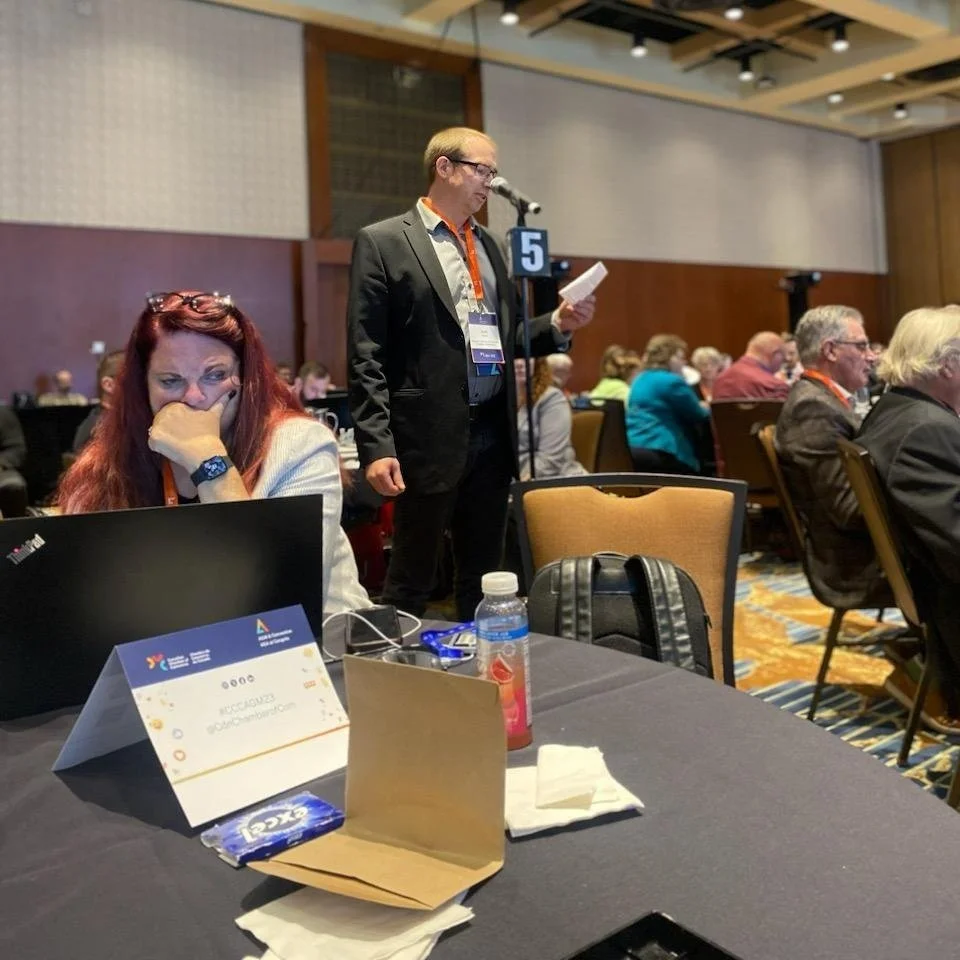
In the Chamber of Commerce context, it often starts with an issue frustrating a local business. A local business person calls up their local Chamber of Commerce to explain the situation and offers some solutions on how the situation could be improved. That Chamber understands that this issue faced by a local business in the Peterborough region is likely having a similar effect on businesses in places like Lloydminster and Fredericton. We work with our local policy committees to draft policy resolutions.
Issues that are provincial in nature are submitted to the Ontario Chamber of Commerce (OCC) with federal resolutions sent to the Canadian Chamber of Commerce (CCC). Once submitted, they get reviewed by committees and Chambers from across the county who then offer their perspectives which in turn help create stronger policy resolutions that are going to be more effective at making change on a large scale.
This last week Chambers and Boards of Trade from across the country met in Calgary for our annual convention, which included nearly six hours of policy debate. There we discuss, amend, and vote on policies that matter to businesses across the country. These resolutions cover a wide range of topics, from fertilizer to ice breakers, from tax reform to bio manufacturing and from immigration to aviation.
If approved, these resolutions become part of the national advocacy platform of the CCC.
Each Chamber or Board of Trade is allowed to submit two resolutions to the CCC annually. Both resolutions submitted by the Peterborough and the Kawarthas Chamber of Commerce were approved thanks to a lot of helpful discussion and recommendations from our fellow chambers over the last few months.
Our resolution Assisting Small Business with Protecting their Data and Business from Cybercrime was put together with the help of a local IT firm and input from several chambers and their members who have IT expertise.
It recommends the Government of Canada:
Broaden the scope of the existing Canadian Digital Adoption Program (CDAP) or create a similar grant program focused on cyber security which will allow SMBs to access comprehensive cybersecurity products and services;
Provide specific annual tax credits for the ongoing support and maintenance required from Third Party vendors for SMEs that have satisfied the grant program to assess their technology;
Allow SMEs to write off 100% of their business investments in preventative cybersecurity-related software, equipment and other costs (support services and outsourcing costs) in the year those investments are made;
Provide a subsidy for training of staff on cybersecurity awareness programs; and
Create a SME Cyber Defence Fund that provides SMEs with the necessary support to improve their cyber resilience and close the cybersecurity investment gap.
Our second resolution, Creating a National Strategy Regarding Healthcare Credentials, was very similar to another submitted by Fredericton Chamber of Commerce. Together, we created an even strong policy resolution calling on the Government of Canada to:
Create a national strategy to assist provinces and territories in recognizing out-of-province and international healthcare credentials; and
Create a national proficiency exam that allows national labour mobility for healthcare workers new to Canada, currently working in a province, or newly graduated.
Approval of the resolutions is just the beginning. The next phase of is advocacy. Two years ago, we had a call from a local restaurant that was feeling anxious about being able to repay their CEBA loan and get the interest-free and debt forgiveness support it offered. That conversation led to a successful policy resolution, which led at first to a one-year extension to the program, and now to a further short extension – thanks in part to the advocacy of the CCC and its platform from its members. While we aren’t done advocating for further support through the CEBA program, we have a united national voice thanks to the voice of a local small business owner who had some valid criticisms of the program and offered helpful solutions.
Hopefully, these resolutions — which started from conversations with local businesses — will go on to create meaningful change for businesses across the country.
Content provided by the Peterborough and the Kawarthas Chamber of Commerce.
Engage with us on social media on Twitter, Instagram, Facebook and Tiktok. Write to us at tips@ptbocanada.com. Sign up for PTBOBuzz newsletter here.
Voice of Business: Hiring People With Disabilities Will Benefit Your Business
/Approximately one million job seekers experiencing a disability in Canada are unemployed or under-employed.

October is Disability Employment Awareness Month (DEAM) and it’s a good opportunity to reflect on a sizeable segment of our population that is being underserved. Back in 2017, Statistics Canada reported 3.7 million working-age Canadians identified as having a disability, yet only three in five were employed.
While the number of job vacancies has declined over the year from its peak of over 1 million, there is still a gap of hundreds of thousands of jobs across Canada that employers are struggling to fill. Employers are eager to hire.
According to the Discover Ability Network, 63 per cent of persons with disabilities do not require accommodations in their workplace. And when they do, the cost or shift in workplace setup is often offset by the productivity of the employed person.
There are more noteworthy statistics:
72 per cent higher employee retention rate among people with disabilities
Businesses hiring people who have a disability experience a 72 per cent increase in productivity
Inclusive businesses grow profits up to 3x faster than their competitors
22 per cent of Canadians have a disability
Inclusive workplaces are twice as likely to meet or exceed financial targets
Hiring people with disabilities not only fills workforce gaps in your business, but will help create a thriving and profitable business with higher retention rates. What’s holding us back?
It turns out one of the biggest barriers is our mindset. An article titled Why Don’t We Hire People With Disabilities? by Angela Kryhul from the Smith School of Business, an affiliate of Queen’s University, gets right to the point. Part of the issue is that we all too often equate disability with an inability to work.
The article highlights three misconceptions:
Few disabled people are qualified for, or apply to, job posts
Accommodations are expensive and complicated
There are negative impacts on productivity and workplace culture
There is a wealth of resources available to employers interested in hiring people with disabilities. The Canadian Association for Supported Employment offers training, resources, and toolkits for employers. The Government of Ontario offers programs, resources, tips and tools. Locally, we have organizations like Heads Up For Inclusion and the Council for Persons with Disabilities offering their expertise and resources working here in Peterborough and the Kawarthas. Our local employment agencies also offer a wealth of knowledge.
It’s time we get a bit out of our comfort zone, tap into local resources, educate ourselves and our teams, and update our hiring practices to include hiring people with disabilities. It will benefit your business, our communities, and our economy.
Content provided by the Peterborough and the Kawarthas Chamber of Commerce.
Engage with us on social media on Twitter, Instagram, Facebook and Tiktok. Write to us at tips@ptbocanada.com. Sign up for PTBOBuzz newsletter here.
Voice of Business: Employment Insurance Premium Rates Planned to Increase
/The costs of many things have gone up, sometimes dramatically, in the last year or so.

Interest rates, fuel, insurance, and wages are just a few cost increases hitting businesses. Now, Employment Insurance Premium rates are planned to increase.
The EI program is designed to be self-sustaining. The Canada Employment Insurance Commission sets annual rates based on a seven-year break-even forecast. Increases in unemployment and temporary support programs introduced during the pandemic have led to a forecasted cumulative deficit of $18.8 billion on Dec. 31.
Employers pay 1.4 times the employee rate. The Canada Employment Insurance Commission is recommending employers pay $2.32 per $100 of insurable earnings, up from $2.28. Employees would also see a larger portion of their paycheque go to EI.
In response to this, the Canadian Chamber of Commerce has issued a letter to Deputy Prime Minister and Minister of Finance Chrystia Freeland and Minister of Employment, Workforce Development and Official Languages Randy Boissonnault.
RE: Potential 2024 Increase in EI Premiums
Dear Ministers,
I’m writing to express our concern about the potential 2024 increase in EI Premiums. EI is a critical program delivered by the federal government. It supports the livelihoods of Canadians and communities during periods of lost income. Temporary program changes in response to the COVID-19 pandemic created a significant deficit that according to the 2023 Actuarial Report on the Employment Insurance Premium Rate led the EI Operating Account to a projected cumulative deficit of $25.2 billion by the end of 2023.
Employers understand that EI is an important temporary job-loss protection program and want to ensure it is effective in supporting their employees during periods of transition. However, increases to EI premiums are effectively a tax on employers who pay a disproportionate amount into the program. Increases to EI premiums must take into account the economic challenges faced by businesses in Canada today, and into the future.
High interest rates, inflation and increased labour costs are making it difficult for small and medium-sized businesses to keep their heads above water. Due to continued strength of the labour market, Budget 2023 stated that the EI Premium Rate would hold steady at $1.63 per $100 of insurable earnings in 2024-2025. We understand EI premiums are being reviewed, and our view is that any increases would be ill-timed and unsustainable at a period when most businesses are struggling to resume normal business operations. It is not fair for employers and employees to pay off the deficit incurred through temporary program changes through increased premiums. Consequently, EI premium rates should be maintained at current levels.
The Canadian Chamber of Commerce represent businesses of all sizes in all sectors and regions of the country, and we would like to emphasize that any proposed changes to EI must balance the need to
support workers while ensuring the program is financially sustainable and promotes a return to the labour force.
Sincerely,
Diana Palmerin-Velasco
Senior Director, Future of Work
Canadian Chamber of Commerce