Peterborough Blogs



Voice of Business: Highlights From Ontario’s Fall Economic Update
/Heading into another period of economic uncertainty, the Government of Ontario recently released the 2022 Ontario Economic Outlook and Fiscal Review titled Ontario’s Plan to Build: A Progress Update.

As per the Ontario Chamber of Commerce (OCC), Ontario’s economic outlook remains uncertain against a backdrop of higher interest rates, inflation, labour shortages, and supply chain disruptions.
The OCC provided a thorough analysis of the economic update. Here are some key highlights for the business community:
Small Businesses the government announced plans to:
Propose $185 million over the next three years in income tax relief for small businesses by expanding the small business Corporate Income Tax (CIT) rate. The new upper end of the phase-out range would be $50 million of taxable income (previously $15 million).
Automatically match property tax reductions for all municipalities that adopt the small business subclass.
OCC analysis: As small businesses grapple with inflation and economic uncertainty, support from the Province will help protect the sector from further closures and ensure they can continue to grow. Additional tax relief through the CIT is welcome as it will make scaling more cost-effective for businesses. Further, the matching of the small business property tax subclass should help incentivize more municipalities to roll out the program outside Toronto and Ottawa.
Other Business Tax Measures the government announced plans to:
Provide $675 million over three years to temporarily allow eligible businesses to expense up to $1.5 million per year for certain capital expenses.
Propose to expand eligibility for Ontario’s film and television tax credits to professional productions distributed exclusively online, and expand eligible expenses for the Production Services Tax Credit to include location fees.
OCC analysis: The proposed tax measures will encourage further business investment in Ontario, including in the tourism industry as it struggles to recover from the pandemic. We encourage the government to work with stakeholders on aligning further tax incentives around key opportunities for business investment in Ontario, such as zero-emission vehicles, clean energy, and mining.
Workforce Development the government announced plans to:
Provide an additional $30 million to the Skills Development Fund, prioritizing training programs that support people facing barriers to employment such as people with disabilities and Indigenous people. Funding will also support priority housing and infrastructure projects across the province.
Provide an additional $4.8 million over two years to expand the Dual Credit program to encourage more secondary students to take apprenticeship and technological education courses, as well as attract more students into the Early Childhood Educator career pathway.
Add additional services to the one‐window digital portal, launched in partnership with Skilled Trades Ontario.
OCC analysis: Widespread labour shortages coupled with ambitious provincial housing and infrastructure targets will require significant action toward workforce development, recruitment, and retention strategies. The OCC welcomes ongoing efforts to address gaps in the skilled trades and early childhood education, alongside opportunities to support greater workforce diversity and inclusion. While the Province continues to work with the federal government to increase Ontario’s allocation of skilled immigrants to meet the demand for labour across sectors (including health care), policymakers need to take further action to address skills mismatches and future workforce needs. This could include working with employers and post-secondary institutions to identify and promote in-demand skills and career opportunities, providing support for reskilling, upskilling, and micro-credentials, leveraging technology and bridging the digital divide.
Red Tape the government announced plans to:
Refocus its red tape reduction efforts toward attracting investment and job creation. This includes clearing provincial supply chain delays, accelerating industrial land approvals and permitting, supporting Ontario’s agri-food system, and removing interprovincial trade barriers.
Establish consultation groups with representatives from key industries to support these efforts.
OCC analysis: Regulatory modernization is one of the most cost-effective tools to boost economic productivity. We are encouraged to see the government signal a renewed focus on high-impact barriers such as permitting and interprovincial trade barriers, which are currently deterring investment in Ontario. Consultation with a broad range of relevant stakeholders will be critical to the success of these reforms.
Cost of Living the government announced plans to:
Propose to extend gas and fuel tax rate reductions so that the tax rates would remain at 9 cents per litre until December 31, 2023.
Propose to double the Guaranteed Annual Income System (GAINS) payment for all recipients (low-income seniors) for 12 months starting in January 2023.
Increase the monthly earnings exemption from $200 to $1000 per month for Ontario Disability Support Program (ODSP) recipients. For each dollar earned above $1,000, the ODSP recipient would also keep 25 cents of income support.
OCC analysis: Record inflation and ongoing affordability challenges continue to impact Ontarians, disproportionately affecting marginalized groups. The OCC welcomes efforts to mitigate those costs in the short term with targeted support for the hardest hit populations, and encourages the Province to explore additional opportunities to improve the cost of living, including by reinstating the Basic Income Pilot Program to assess program costs and benefits for Ontarians. The OCC and our members also look forward to providing feedback on the development of a provincial portable benefits program, as well as forthcoming consultations related to a target benefit pension plan framework for Ontario.
Next week we’ll look at what’s missing from the Ontario Economic Outlook and Fiscal Review and look at what will help create a clear and predictable path toward long-term growth, productivity, resilience and competitiveness.
Content provided by the Peterborough and the Kawarthas Chamber of Commerce.
Engage with us on social media on Twitter, Instagram, Facebook and Tiktok. Write to us at tips@ptbocanada.com. Sign up for PTBOBuzz newsletter here.
Voice of Business: Fall Economic Statement Highlights Upcoming Business Supports
/Forecasting our economic future is challenging to say the least.

Economists are using phrases like “there’s no playbook for this.” It’s tough to find data on how global economies will react after going through years of global pandemic, a war in Europe, and record inflation that governments are trying to cool through measures that will likely lead to recession.
What we do know is that many of our current challenges aren’t going away in the short term and new struggles will likely arise in months to come.
On that note, the federal government’s Fall Economic Statement was heavy on supports and vision for building toward future goals.
You can read the full Fall Economic Statement here, but some key takeaways for the business community include:
Net-Zero
The Government of Canada is making it clear that our future lies in investments in reaching net-zero. This includes training the workforce for sustainable jobs, attracting private sector investment to projects that reduce emissions and drive innovation in technologies that help achieve Canada’s climate targets, investing in clean technology manufacturing, and building our critical mineral strategy to grow our economic with sustainably developed clean technologies and goods.
Additionally, the federal government plans to roll out a tax credit for investment in clean technology. This refundable tax credit of 30 per cent would offset costs for investing environmentally-friendly electricity generation, storage, heating equipment, industrial zero-emission vehicles.
Transportation
The government is taking action the National Supply Chain Task Force’s recommendations, including addressing regulatory issues to improve efficiency and resiliency of our supply chains, modernizing cargo and clearance inspection practices, improving data reporting and monitoring, and investing in improving access to our international gateways.
Innovation
The government plans to launch a Canadian Innovation and Investment agency to work to help new and
established Canadian firms innovate, commercialize research, and create new economic opportunities for workers and businesses in Canada. The government is also planning to modernize the National Research Council’s scientific infrastructure and help continue to propel Canadian innovation.
Infrastructure
Investing in Canada Infrastructure Program is providing $33.5 billion for public infrastructure across Canada. Under this program, provinces and territories prioritize and submit projects to Infrastructure Canada for review.
Immigration
The federal government is looking to boost immigration to 500,000 immigrants in 2025 with a focus on skilled labour sectors that are struggling with workforce shortages, including healthcare, manufacturing, and the building trades.
Taxation
The government is looking to create a Scientific Research and Experimental Development tax incentive program, introduce a corporate-level 2 per cent tax that would apply on the net value of all types of share buybacks by public corporations in Canada, and reaffirmed its commitment to the global minimum tax on large corporations.
The quarterly economic statements are a tool to highlight the previous budget allocations in more detail while hinting at what is to come in the next year’s budget.
For the upcoming 2023 federal budget, the Ontario Chamber of Commerce has set out some priorities for the federal government:
Increase Ontario’s allocation of economic immigrants under the Ontario Immigrant Nominee Program, address the backlog of immigrants, and streamline recognition of foreign credentialing for sectors with pressing labour shortages.
Invest in supply chain infrastructure to address bottlenecks along the supply chain, especially at ports.
Protect Canada’s clean energy advantage by optimizing existing assets – such as nuclear and hydroelectricity – as well as incentivizing long-term investments in emerging technologies such as carbon capture and zero-emission vehicles.
Modernize regulatory frameworks to enable growth in industries like mining and cannabis.
Prioritize working with provinces and territories to remove barriers to interprovincial labour mobility and trade.
• Increase Canada Health Transfer Payments to meet the current and future pressures facing Canada’s universal health care system.
Reform the federal tax system to attract foreign direct investment, drive domestic business growth and innovation.
It’s hard to predict what exactly will unfold in coming months. Whether we’re in recession, recovery, or growth — investing in the private sector is crucial to our success in moving toward goals of reducing greenhouse gas emissions and generating economic prosperity across Canada.
Content provided by the Peterborough and the Kawarthas Chamber of Commerce.
Engage with us on social media on Twitter, Instagram, Facebook and Tiktok. Write to us at tips@ptbocanada.com. Sign up for PTBOBuzz newsletter here.
Voice of Business: A Healthy Workforce Drives Efficient and Productive Businesses
/When it comes to investing in our businesses, some areas are easier to convert to dollars and cents return on investment.

In a time when many businesses are struggling to attract talent, it’s critical that we invest in the workforce we have. According to JobSage, 28 per cent of surveyed workers left their jobs due to poor mental health.
According to a report from the Canadian Mental Health Association (CMHA), it’s estimated that 12 billion worked days are lost every year to depression and anxiety, costing about $1 trillion US in lost productivity.
According to Occupational Health and Safety Canada Magazine, mental health services cost Canada $50 billion annually, with $20 billion stemming directly from workplace trauma. Deloitte found poor mental health accounts for 30 – 40 per cent of short-term disability claims and 30 per cent of long-term disability claims.
Poor work environments, including discrimination, inequality, excessive workloads, low job control and job insecurity all pose risks to mental health. This all comes on top of stresses from home and more than two years of dealing with a global pandemic.
While mental health struggles happen outside of the work environment, the nature of our place of work being where many of us spend more waking hours than anywhere else means that whether or not the workplace is contributing to the situation, it certainly plays a role in how someone is able to deal with it.
According to the Mental Health Commission of Canada:
Workplaces can play an essential part in maintaining positive mental health. They can give people the opportunity to feel productive and be a strong contributor to employee wellbeing. Yet it can also be a stressful environment that contributes to the rise of mental health problems and illnesses. No workplace is immune from these risks and we cannot afford to limit our definition of occupational health and safety to only the physical.
The CMHA offers a number of workplace mental health solutions for employers across Canada:
Not Myself Today: Through this employee wellness platform, employees can access helpful tips, learning modules and other resources to improve their mental health at work. The platform helps to build an open and supportive workplace by cultivating meaningful conversations and deeper understanding about mental health and wellness in the workplace.
Customized Training: CMHA offers in-person or virtual workshops based on the needs and interests of your employees. From building resilience and managing stress, to returning to work and coping with change, their facilitators can work with you to deliver the right workplace mental health training for your team.
Psychological Health & Safety Courses: Psychological Health & Safety training is designed for individuals who are working to improve psychological health and safety in their workplaces and/or to implement the National Standard of Canada for Psychological Health and Safety in the Workplace.
It’s often easier to see the direct results of investing in skills, training and the physical health of our workforce. But mental health is too big of a deal not to invest in. These investments can lower turnover, increase productivity, and reduce absenteeism. A mentally healthy workplace is not just going to show up, but be there ready to engage, innovate and help a business thrive.
Content provided by the Peterborough and the Kawarthas Chamber of Commerce.
Engage with us on social media on Twitter, Instagram, Facebook and Tiktok. Write to us at tips@ptbocanada.com. Sign up for PTBOBuzz newsletter here.
Voice of Business: Business Supports Help Our Region Recover Together
/As our economy shifts into recovery mode so have the funding lifelines.

We’ve moved from emergency funding to get through shutdowns to investing in what our businesses need to deal with current challenges and position them for the future.
Here is a brief rundown of some of the programs available:
Talent Opportunities Program (Up to $7,000)
Are you an employer hiring post-secondary students on work-integrated learning (WIL) placements, such as cooperative education and internships? If so, you may be eligible for a wage subsidy of up to $7,000 per student!
The Talent Opportunities Program (TOP) is an initiative of the Ontario Chamber of Commerce designed to help employers located anywhere in Canada hire college and university students on WIL placements. Employers hiring eligible students may receive a wage subsidy up to 50% of the wages (to a maximum of $5,000) for each ‘net new’ placement or 70% of the wages (to a maximum of $7,000) for each ‘net new’ placement for the following under-represented groups: Indigenous people, person with disabilities, newcomer to Canada, first year student, visible minority and/or women in STEM.
https://occ.ca/talent-opportunities-program/
Grow Your Business Online Grant (Up to $2,400)
As part of the Canada Digital Adoption Program, the Government of Canada has partnered with the Ontario Chamber of Commerce to deliver the Grow Your Business Online grant.
Through this program, small business owners can receive a micro-grant worth up to $2,400 to help get their business online, give their e-commerce presence a boost, or digitalize business operations. Grant recipients must commit to maintaining their digital adoption strategy for at least six months.
https://occ.ca/growyourbusinessonline/
Boost Your Business Technology (Up to $15,000 + 0% loan)
Eligible businesses can leverage the grant to pay for the services of a digital advisor. These advisors will work with companies to recommend digital pathways and strategies that will help them achieve their business goals and increase their competitiveness in the digital economy.
The grant covers up to 90% of the eligible cost of retaining the services of a digital advisor, up to a maximum grant value of $15,000 per SME, to develop a digital adoption plan.
Businesses also have the opportunity to secure a 0% interest loan from the Business Development Bank of Canada (BDC) to facilitate the acquisition of new technology. In addition, applicants can leverage the help of talented post-secondary students and recent graduates through subsidized work placements.
https://ised-isde.canada.ca/site/canada-digital-adoption-program/en/boost-your-business-technology
Canada-Ontario Job Grant (Up to $10,000)
The Canada-Ontario Job Grant provides direct financial support to individual employers or employer consortia who wish to purchase training for their employees. It is available to small, medium and large businesses with a plan to deliver short-term training to existing and new employees.
Businesses can get some assistance from local employment organizations.
https://www.tcu.gov.on.ca/eng/eopg/cojg/
Digital Main Street (Up to $2,500 + free training)
Peterborough and the Kawarthas Chamber of Commerce has partnered with acorn30 to provide local businesses with a Digital Main Street Digital Service Squad. Squad members are available for free one-on-one assistance to small businesses to assess their digital needs and create plans to meet digital goals. The squad can also help businesses apply for a $2,500 Digital Transformation Grant to put toward digital marketing, website work, software, training, and hardware.
For more info, contact Clarance D'Silva clarance@acorn30.com or visit https://digitalmainstreet.ca/ontariogrants/
Government of Canada Business Benefits Finder
The Government of Canada now has a business benefits finder to help businesses find the right programs and services, whether you’re starting out or scaling up. Enter some details about your business and it will pull up all the available federal programs.
https://innovation.ised-isde.canada.ca/s/?language=en_CA
Available funding opportunities from the Ontario Government
The Government of Ontario has a single-point access page listing current business support programs for various sectors, skills, and workforce investments.
https://www.ontario.ca/page/available-funding-opportunities-ontario-government
Community Futures Peterborough (Micro Loans up to $20,000, Small Business Loans up to $250,000)
Community Futures Peterborough offers a range of supports for small businesses, including counselling, training, and loans.
https://communityfuturespeterborough.ca/financing-services/
This is by no means an exhaustive list. As a Chamber, our role involves helping businesses overcome barriers. Sometimes this involves sorting out bureaucracy and cutting red tape. Other times it involves advocating for funding to help specific sectors get the boost they need to ensure they aren’t being left behind. Our region needs businesses of all sizes and sectors thriving for an effective and efficient economic recovery.
Content provided by the Peterborough and the Kawarthas Chamber of Commerce.
Engage with us on social media on Twitter, Instagram, Facebook and Tiktok. Write to us at tips@ptbocanada.com. Sign up for PTBOBuzz newsletter here.
Voice of Business: Unemployment Declines As Jobs Increase But the Situation Remains Challenging
/Unemployment declines as jobs increase, but the situation remains challenging.

Canada’s employment situation remains fickle.
We’ve added more jobs and the unemployment rate has declined, but people are working fewer hours and the overall labour shortage still sits at more than 1 million unfilled jobs.
According to Canadian Chamber of Commerce Chief Economist Stephen Tapp:
“At first glance, it looked like we finally received good news from Canada’s Labour Force Survey for September: after three months of declines, employment was up by 21,000 jobs, while the unemployment rate dropped back to 5.2 per cent after unexpectedly spiking to 5.4% last month. Digging beneath the headlines, however, shows emerging signs of an underlying “cooling-off” period. First, hours worked are down over 1per cent since June. Second, labour force participation has sagged over the course of this year, and third, it’s the public sector, not the private sector, that continues to push up employment. That said, Canada’s labour market remains historically tight. It remains difficult for businesses to fill the nearly one million vacant positions they’re seeking. And, though, wage growth exceeded 5 per cent for the fourth month in a row, this still isn’t enough to boost workers’ purchasing power, as it’s below the highest rates of inflation seen in a generation.”
Overall, the public sector added 35,000 jobs, compared to 9,000 from the private sector while self-employment dropped by 22,000. The increase in employment is being driven by education and healthcare at 46,000 and 24,000, respectively. This offset declines from manufacturing (-28,000); information, culture and creation (-22,000); transportation and warehousing (-18,000), and public administration (-12,000).
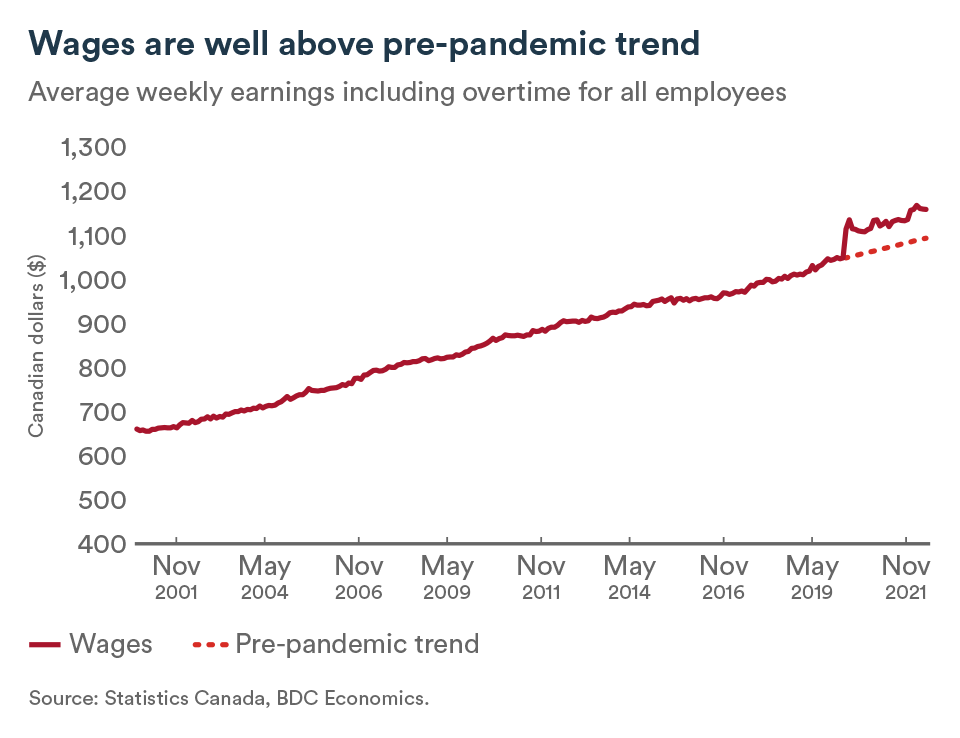
Wage growth is being led by professional services, up 9.1 per cent year-over-year, followed by accommodation and food service at +8.7 per cent over last year. On average, wages are up 5.2 per cent over last year.
Adding further pressure to workforce challenges is the trend toward retirement shows no signs of slowing, with 1 million of the 5.2 million Canadians aged 55 -64 already retired.
Overall, Ontario and PEI are the only provinces seeing a decline in employment.
Locally, jobs in demand largely hit sectors that have struggled heavily over the last two years, especially the service industry. According to the Workforce Development Board, the top 10 local job postings are for:
Retail salespersons
Food counter attendants, kitchen helpers & related support occupations
University professors and lecturers
Home support workers, housekeepers & related occupations
Other customer & information services representatives
Retail & wholesale trade managers
Cooks
Social and community service workers
Post-secondary teaching & research assistants
Light duty cleaners
Employment data will continue to fluctuate, as it always has. But it reveals the harsh reality that some sectors are rebounding well while others are going to continue to struggle. Those who regularly had to cut staffing levels due to public health restrictions are struggling to hire enough staff despite being leaders in increasing wages. There is no large pool of workers waiting to return and fill the vacancies across the country. It’s going to take creativity, investment, and vision for local businesses to modernize, automate, and adjust how they operate to make do with less access to labour.
Content provided by the Peterborough and the Kawarthas Chamber of Commerce.
Engage with us on social media on Twitter, Instagram, Facebook and Tiktok. Write to us at tips@ptbocanada.com. Sign up for PTBOBuzz newsletter here.
Voice of Business: How We Get To Net-Zero Matters
/Climate change is a pressing business issue.

We’re dealing with the effects on a regular basis with extreme weather events happening far more frequently than decades ago. Referring to disasters as once-in-a-century events has lost its relevance. Floods, wildfires, wind storms, and hurricanes have shuttered businesses, cut off supply chains, spoiled goods, and taken lives. And we’re paying the insurance premiums to prove it.
All levels of government have pledged some form of commitment toward reducing greenhouse gas emissions and tackling the effects of climate change.
The federal government has established its goal of creating net-zero emissions by 2050 with Environment and Climate Change Canada supplementing it with the 2030 Emissions Reduction Plan. It established the Net-Zero Advisory Body in 2021 as a group of independent experts to provide advice on pathways for Canada to achieve net-zero emissions. The Canadian Chamber of Commerce (CCC) Net-Zero Council is part of this advisory body.
The CCC along with partners at PwC Canada have put together a report titled How We Get There Matters: Establishing a Path to Net-zero in Canada. It has four core principles:
1. The 2030 roadmap must firmly position Canada to achieve its net-zero target for 2050
This means that a key goal of actions taken between now and 2030 should be to enable delivery of the 2050 target, rather than short-term measures that may help deliver on 2030 targets but cannot be leveraged thereafter. These actions may consist of pilot programs, feasibility studies and consultations to position initiatives for major emissions reduction in the coming decades. In the absence of this, we risk our ability to reach our net-zero goal and/or risk needing to resort to extreme measures in later years.
2. Canada’s net-zero plan must be tightly coupled with its economic goals
This will ensure that fulfilling Canada’s commitment to contribute to the global fight against climate change and maintaining/improving our standard of living will not be seen as either/or.
3. Canada’s economic plan and the net-zero transition plan must consider the global context
This consideration is necessary to protect competitiveness of Canadian businesses and avoid carbon leakages to other countries.
4. Canada’s net-zero plan should deliver an orderly and inclusive transition
This is critical to avoid economic crises and energy crises and to ensure the ongoing support of Canadians for Canada’s commitment to net-zero.
Among its key recommendations are that Canada should:
Increase overall net-zero funding and do more to de-risk and address barriers to private
sector investment
Adopt a common definition for what constitutes investment that supports net-zero
Consider a holistic picture of emissions
Design policy options to incentivize emission reductions in Canada’s international
Supply chains
Develop a detailed net-zero skills plan to unlock the opportunities that net-zero will bring
Develop a plan for funding decarbonization equitably
Develop a public engagement and information strategy
It’s going to take intentional investment from both the private and public sector to tackle climate change and make meaningful reductions in greenhouse gas emissions. At this point, all options involve significant investments and costs — including inaction. It’s critical that we work as effectively and efficiently together across sectors to make the best use of time and money and position us to be competitive now and in the future. As the report says right at the start — how we get there matters.
Content provided by the Peterborough and the Kawarthas Chamber of Commerce.
Engage with us on social media on Twitter, Instagram, Facebook and Tiktok. Write to us at tips@ptbocanada.com. Sign up for PTBOBuzz newsletter here.
Voice of Business: Municipal Elections Are Opportunities to Shape the Future of Our Region
/Elections are a crucial time for engaging with our future leaders and sharing our ideas and vision for what the future should look like.
No government has more of a hands-on impact on our day-to-day lives than our local municipalities.
Election campaigns are often viewed as a one-way message — what will you (or your party) do for us? What really sets municipal campaigns apart from federal and provincial candidates is the community-level engagement. Many council candidates will knock on every door in their ward, some more than once. They are there just as much to hear what you have to say as they are to spread their message about their platform.
It's also representation on a whole different scale. We currently have 113 candidates vying for 51 elected positions in the City and County, a notable increase from the three MPs and MPPs that cover our region (and beyond).
Some may have party affiliations and political leanings, but that’s as far as it goes. Each candidate fundraises for themselves, sets their own platform, and represents their own ideals. This type of campaign offers a high level of flexibility. The questions you ask are just as important as the answers they provide. It sets the tone for what our community values.
That’s why we at the Peterborough and the Kawarthas Chamber of Commerce decided to go all-in this municipal election in terms of engaging both candidates and the community. We are strictly non-partisan in terms of promoting any specific candidates or ballot questions. Our goal is to engage candidates and the public to be informed on local business issues that will guide the future of our region for years to come.
Watch Peterborough County township debates:
If you are a resident of a township in the County of Peterborough or just want to get up-to-date on local issues and candidates, last week we hosted debates via Zoom in all eight townships. You can view all of these recorded debates here: https://www.peterboroughchamber.ca/2022-municipal-election.html
City council questionnaire:
All candidates running for positions on council were sent a questionnaire with 10 questions relating to local business and community issues. We began publishing their responses yesterday on our website: https://www.peterboroughchamber.ca/2022-municipal-election.html
City mayoral debate
Join us Thursday, Oct. 6 for a City of Peterborough mayoral candidates debate at Market Hall. Doors open at 6:30 p.m. and the debate will start at 7 p.m. Please note that seating is limited and first come, first served. We will also be live streaming it on our YouTube channel, which will later be published on our website and aired on YourTV.
An engaged and informed community is most effective when people vote. For details on how to vote in your municipality, go to:
City of Peterborough
Township of Asphodel-Norwood
Township of Cavan Monaghan
Township of Douro-Dummer
Township of Havelock-Belmont-Methuen
Township of North Kawartha
Township of Otonabee-South Monaghan
Selwyn Township
Municipality of Trent Lakes