Three Students Off to Compete In Edmonton After Placing As Top Three Entries At Peterborough Regional Science Fair
/Claire Sehn, Ella Sehn and Isaiah Jalsevac are headed to Edmonton to compete in the Canada-Wide Science Fair after placing in the top three as the grand prize winners at the Peterborough Regional Science Fair at Trent University on Wednesday.
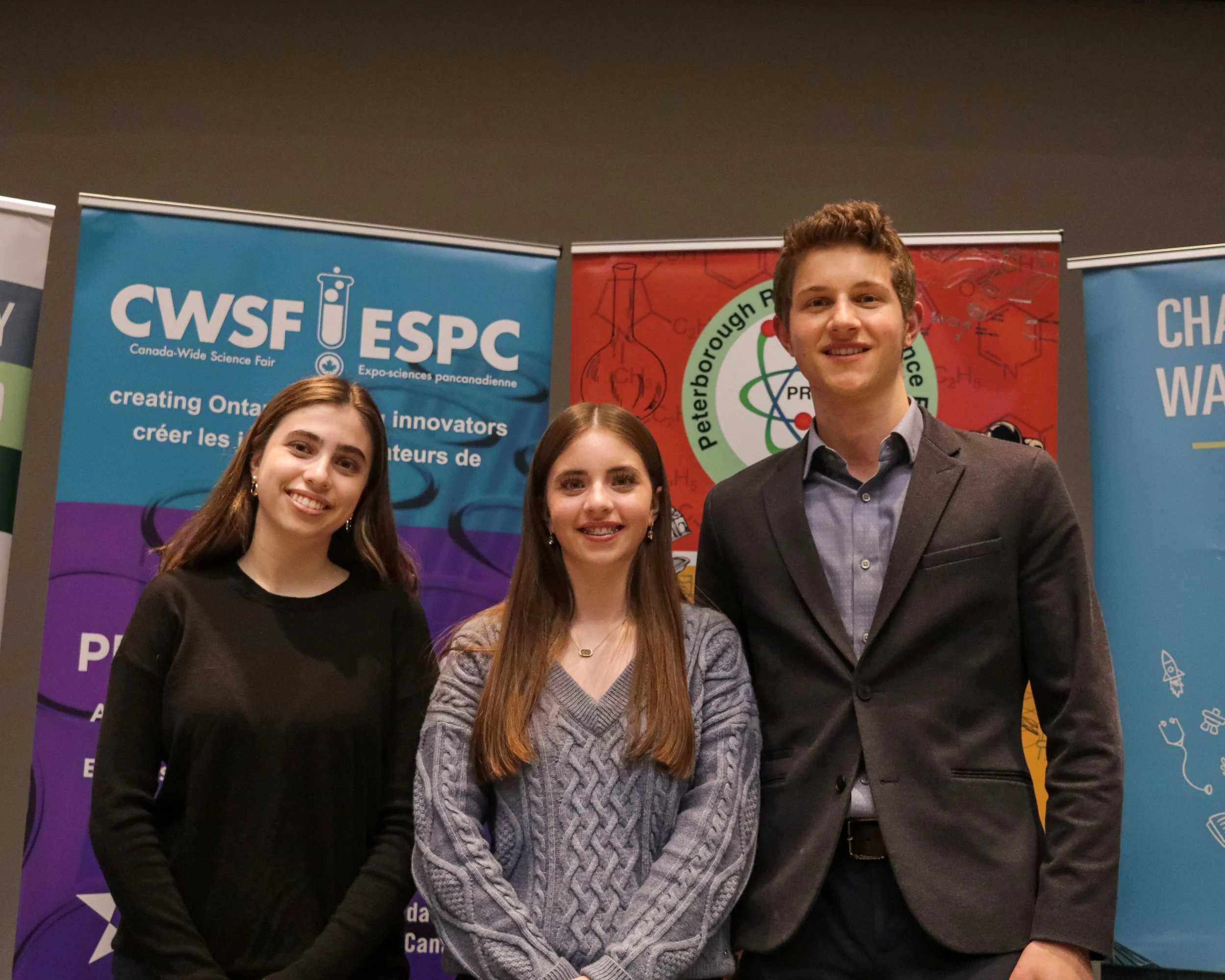
Third-Place finisher Ella Sehn (left); Winner Claire Sehn (middle) and runner-up Isaiah Jalsevac (right) are all headed to Edmonton after thEir top-three finish at the Peterborough Regional Science Fair. tHE TRIO WERE ALSO TOP THREE IN LAST YEAR’S EVENT. Photo courtesy of Peterborough Regional Science Fair.
Students from Kindergarten to Grade 12 competed in several different divisions and categories, showcasing their projects.
The following were the top three grand prize projects:
A Novel, Biodegradable Treatment to Limit Drought and Wildfire Disaster and Retain Soil Nutrients by Claire Sehn of Lakefield College School (first place)
Our planet is facing serious environmental crises: global warming is causing wildfires, drought is decimating agricultural yields, and waning soil fertility is hindering crop growth. Current approaches to address these issues are generally singular in focus and limited in efficacy.
A biodegradable treatment capable of retaining moisture, limiting combustion, and sustaining nutrients could address these environmental challenges simultaneously. A novel treatment was engineered, consisting of hydrogels created from pineapple peel, pine needles or corn husk; calcium carbonate from milled mussel shells; and engineered wheat-based biochar. Four treatment groups, including a control, were applied to 20 soil samples and the moisture percentage was measured daily for five days.
Treatments were applied to 40 wood samples and were subjected to combustion tests. Four different combustion studies were measured. Trials involving mussel shells and biochar or the combination were brought to equilibrium in a 10 parts per million fertilizer: water solution and the nutrient adsorption percentage was measured using ion chromatography. The triple combination treatment demonstrated the ability to mitigate the effects of wildfire and drought by improving water retention (p<0.05) and limiting fire combustion (p<0.05) using standardized tests. The treatment was also effective in adsorbing phosphate and nitrate, thereby improving soil health. BET surface area analysis demonstrated that the engineered biochar had a surface area of 2 m^2/g. Raman spectroscopy and infrared spectrometry validated the structural characteristics of the engineered biochar and compost-based hydrogels. This study demonstrates the efficacy of manufacturing compost-based environmental protection treatments from materials readily available in Canada.
Firebird: Autonomous UAV Detection and Monitoring of Wildfires by Isaiah Jalsevac of Our Lady of the Wayside Catholic School (runner-up)
Wildfires are an increasing concern as climate change decreases precipitation, causes earlier snow melt, and increases the likelihood of fires. They can cause undue harm to wildlife if left unchecked, cause people to have to evacuate, and cause vast smoke clouds to cover huge tracts of land. Also, wildfires are a huge factor in greenhouse gas emissions, releasing massive amounts of CO2 into the atmosphere.
In 2023, more CO2 was released into the atmosphere from wildfires than from all other sources in Canada combined. Early detection is the most effective method for limiting wildfire damage - a small fire is easy to put out, a raging fire that has been burning for days is not. This project seeks to address gaps in the current detection methods by creating a long-range, autonomous UAV capable of flying for hundreds of kilometres and detecting wildfires from their thermal signatures.
This project focuses on three main areas: iterative simulations to design the optimal airframe for a long-range UAV, designed specifically for detecting wildfires; different detection algorithms and their accuracy at detecting wildfires; and different approaches to optimally deploy these UAVs and maximize detection coverage.
Removal of Aquatic Microbial Biocontaminants with Ozonide: An Assessment of Apoptosis in Wildtype and CRISPR-Cas9 iPT Homozygous Knockout Cell Lines by Ella Sehn of Lakefield College School (third place)
Microbial blooms biocontaminate the drinking-water sources relied on by over 100 million people worldwide. The removal of these water biocontaminants could substantially improve global health. Recent microbial studies have identified an indirect connection between the gene iPT and cell stress tolerance but its role in regulating cell survival remains incompletely understood.
Ozonide is a chemical capable of lysing cell membranes through depolymerization. The objectives of this research were twofold: first, to determine the functional implications of iPT in regulating cell survival, and second, to determine the capacity of ozonide to induce apoptosis (cell death) in microbial cells. iPT was deleted from the Euglena Gracilis genome using CRISPR-Cas9 to generate a line of homozygous iPT-knockout cells (-/-). Apoptosis was assessed in these knockouts in comparison to wildtype cells (+/+).
Second, the capacity of ozonide to induce apoptosis in both cell lines was assessed by its application in concentrations of 10, 100 and 1000 µg/mL. To quantify apoptosis, four assays were employed: DNA and RNA electrophoresis, cell viability and RT-qPCR for Metacaspase gene expression. The -/- cells showed far lower viability and higher expression of the Metacaspase genes. Further, the application of ozonide resulted in a substantial increase in apoptosis, as shown by hallmark ladder-patterns in the DNA and RNA electrophoresis, low cell viability and upregulation of the Metacaspase genes.
Statistical analyses are currently ongoing. These results revealed a novel function of iPT in regulating cell survival. Additionally, ozonide was identified as a novel treatment for microbial blooms with potential to benefit global health.
@ptbo_canada Claire Sehn, Ella Sehn and Isaiah Jalsevac are headed to Edmonton to compete in the Canada-Wide Science Fair after placing in the top three as the grand prize winners at the Peterborough Regional Science Fair. #ptbocanada #journalism #fyp #news #sciencefair ♬ Science - ZydSounds