
Ontario Government Invests $6.4 Billion to Support Postsecondary Sector’s Long-Term Success and Sustainability
/To protect postsecondary students’ access to education and help them launch successful careers, the Ontario government is investing $6.4 billion in postsecondary institutions to ensure long-term success and sustainability, announced at Trent University on Friday.
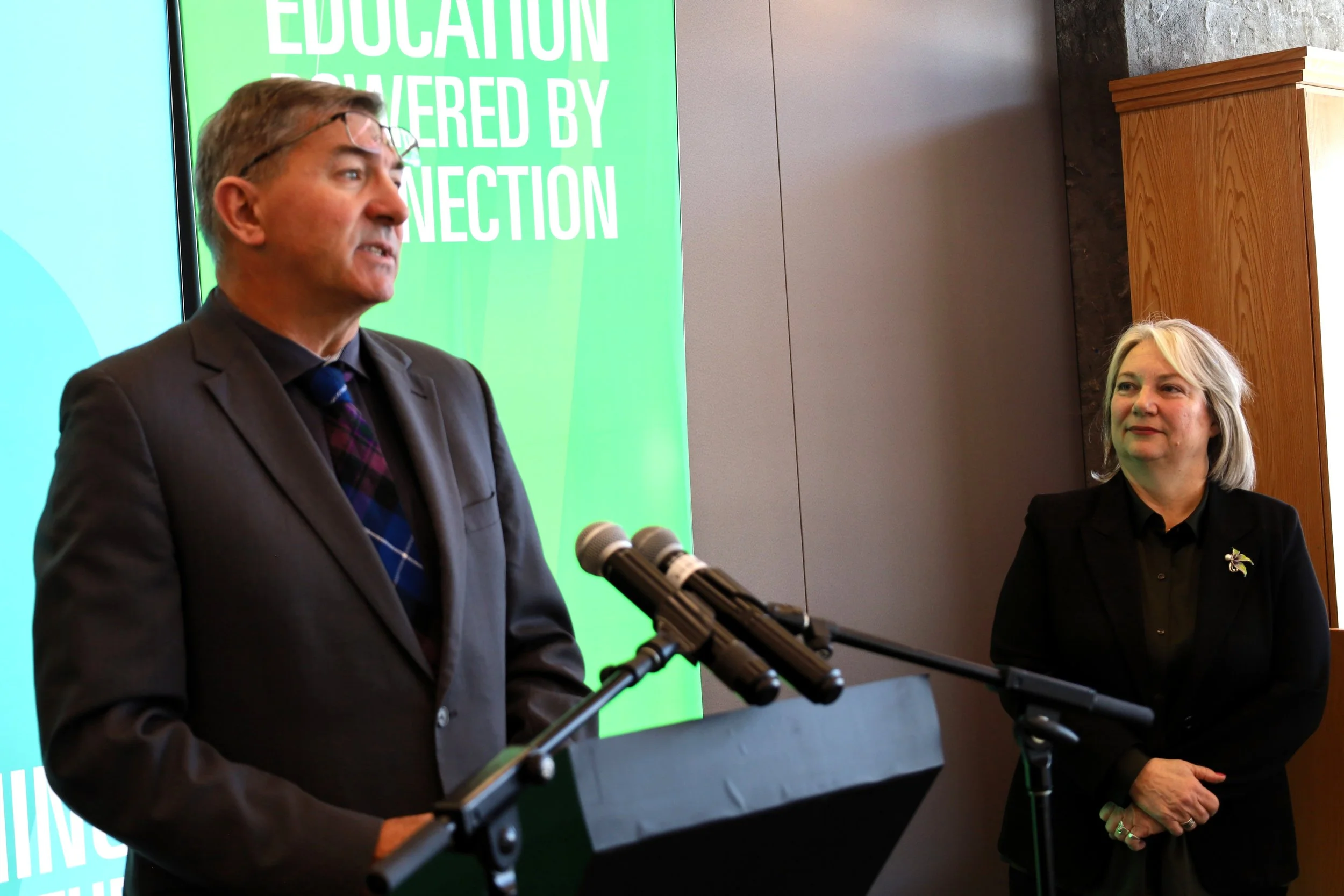
Dave Smith, Peterborough-Kawartha MPP (left) and Dr. Cathy Bruce, Trent University president and vice-chancellor (right) as joint announcements were made at Trent’s Bata Library. Photo by David Tuan Bui.
Accroding to the Ontario Government, its plan to build a stronger postsecondary sector is based on three principles:
Preparing students for rewarding, in-demand careers that meet labour market needs
Preserving Ontario students’ ability to access high-quality postsecondary education, while supporting their ability to appropriately invest in their education and success
Providing Ontario’s postsecondary sector long-term sustainability, while continuing to ensure funding for the sector is being used to further Ontario’s position as a centre for world-class research excellence while meeting student and labour market needs
Federal changes have significantly reduced international student revenues and the province is also facing increased domestic demand for higher-cost programs and a financial aid program (OSAP) that is dramatically out of line with other jurisdictions.
According to a press release, to ensure the province’s world-class institutions continue producing one of the most competitive workforces in the G7 for generations to come, the Ontario government is making the following changes starting in Fall 2026:
A new long-term funding model will see universities, colleges and Indigenous Institutes focused on delivering programs that align with student and labour-market demand supported by increased, predictable funding. This new long-term funding model will bring an additional $6.4 billion into the sector over four years and raise annual operating funding to $7 billion, a 30 per cent increase and the highest level in the province’s history. It will also fund 70,000 more in-demand seats, while better meeting the needs of small, rural, northern, French-language and Indigenous Institutes
An updated tuition framework will support the postsecondary sector’s long-term sustainability while maintaining one of the lowest tuition increases in Canada. Ontario will allow publicly assisted colleges and universities to raise tuition by up to two per cent per year for three years, then by up to two per cent or the three-year average rate of inflation, whichever is lower, in the years that follow. This rate of increase will be among the lowest in Canada, comparable to that of British Columbia and Manitoba.
On average, this change will result in an additional cost of $0.18/day for college students and $0.47/day for university students. Low-income students will have this cost absorbed through an enhanced Student Access Guarantee (SAG)
A stronger, more sustainable OSAP system will ensure financial assistance remains available for future generations while supporting students’ appropriate investment in their education and success. To strengthen the long-term sustainability of OSAP and align it with other provinces, Ontario students will be eligible to receive a maximum of 25 per cent of their OSAP funding as grants and a minimum of 75 per cent as loans. OSAP will no longer offer grants to students at private career colleges, in alignment with changes the federal government has made to its student support funding.